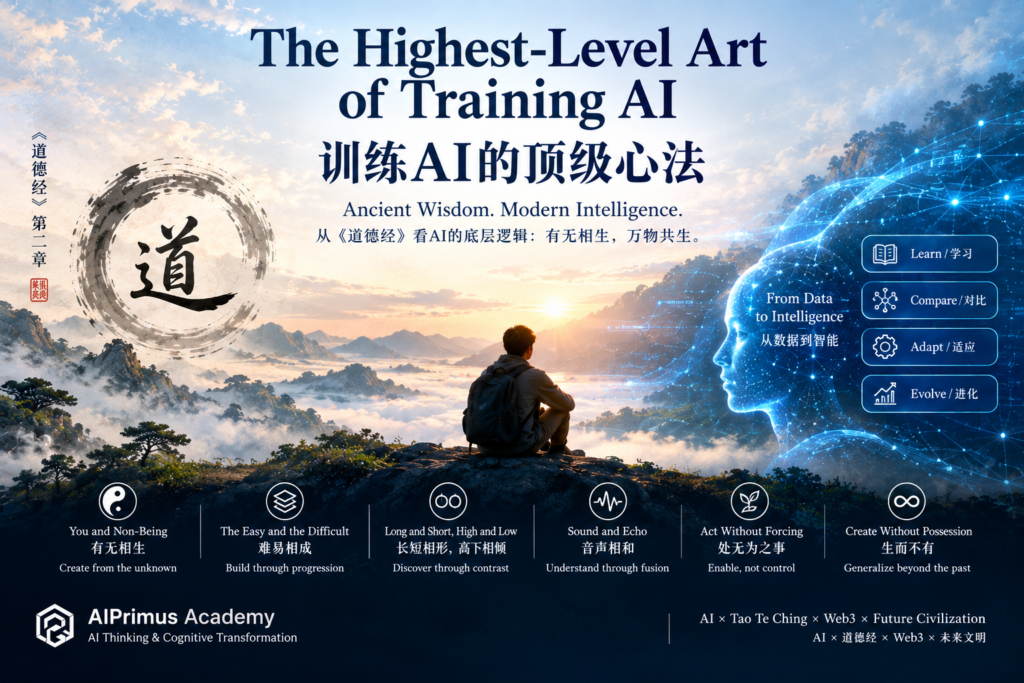
You Think AI Was Invented in America? Some of Its Deepest Ideas Echo an Ancient Chinese Classic.
I know someone who teaches AI to companies.
Last year, he was hired to train a group of employees on how to use large language models.
He prepared a hundred-slide presentation.
Neural networks.
Transformers.
Attention mechanisms.
Loss functions.
He explained everything he could think of.
Then, in the middle of the session, a business owner in his fifties raised his hand.
He asked one question:
“Can you tell me how this thing actually learns to become intelligent?”
My friend froze.
He had prepared a hundred slides.
But somehow, he had not prepared for that question.
The funny thing is that you can begin answering it through a few lines from the Tao Te Ching, written more than two thousand years ago.
One of its most important ideas is:
“Being and non-being give rise to each other.”
— Tao Te Ching, Chapter 2
Don’t rush to call this mystical.
Look at how modern AI actually learns.
You may discover that some of the deepest principles of machine learning have a surprisingly familiar shape.
01|How AI Learns Language: Hide the “Something” and Let It Infer the “Nothing”
Have you ever done a fill-in-the-blank exercise?
Imagine a sentence:
“Tom was in a great mood today. He had a ______ on his face all morning.”
You might fill in:
smile.
Simple.
But think about what your brain actually did.
You didn’t just memorize the word smile.
You understood the relationship between:
- “great mood”
- “face”
- human expression
- emotional context
- the structure of the sentence
Then you inferred the missing word.
This is remarkably close to one of the fundamental ideas behind modern language-model training.
During training, parts of the input can be hidden or withheld, and the model is asked to predict what belongs there.
The visible information becomes the context.
The missing information becomes the target.
The model repeatedly learns to infer what is absent from what is present.
In the language of the Tao Te Ching:
有无相生 — being and non-being give rise to each other.
The interesting part is not simply that AI sees enormous amounts of data.
It is that AI learns through the relationship between what is present and what is missing.
It makes predictions.
It receives feedback.
It adjusts.
Then it tries again.
Millions, billions, and trillions of times.
No one needs to sit beside the model and explain every possible meaning of every word.
Instead, the training environment creates conditions in which the model can gradually discover statistical structure, relationships, patterns, and representations.
That is a profound idea for education as well.
The highest-level training does not simply provide answers. It creates a situation in which the learner has to discover the answer.
AI learns this way.
Humans do too.
02|How Do You Teach Something Difficult?
Don’t Start With the Difficult Part.
Imagine teaching mathematics to a six-year-old.
Would you begin with calculus?
Of course not.
You start with numbers.
Then addition and subtraction.
Then multiplication.
Then more complicated concepts.
Why?
Because difficulty does not exist independently of simplicity.
The difficult is built layer by layer on top of the easy.
This idea has a modern counterpart in machine learning:
curriculum learning.
Instead of presenting a model with the most complicated examples immediately, training can progress from simpler patterns toward increasingly difficult ones.
Think about teaching a child to ride a bicycle.
First, training wheels.
Then one training wheel.
Eventually, none.
The simple stage does not disappear.
It becomes the foundation of the more advanced stage.
This echoes another famous line from the Tao Te Ching:
“The difficult and the easy complete each other.”
We often look at experts and see only the final result.
We see someone who can analyze a complex business problem, write sophisticated software, trade markets, or design an AI system.
What we don’t see are the thousands of simple patterns underneath that ability.
The same is true of AI.
A powerful model is not built by throwing complexity at it.
It is built by allowing increasingly complex structures to emerge from simpler ones.
So the next time learning feels painfully difficult, don’t immediately conclude that you are not smart enough.
Ask a different question:
Did I skip the “easy” layer and jump directly into the “difficult” one?
Sometimes the problem isn’t intelligence.
It’s sequencing.
03|How Does AI Learn to Recognize Beauty? Through Comparison.
This is where things get particularly interesting.
Imagine someone who has never seen a cat or a dog.
How would you teach them to tell the difference?
You could show them a picture of a cat and say:
“This is a cat. It has four legs, a tail, pointed ears…”
But there is a problem.
A dog also has four legs.
A dog can also have a tail.
A dog can also have pointed ears.
The more you try to define something through absolute rules, the harder the distinction can become.
So try another method.
Show them ten cats.
Then show them ten dogs.
Don’t immediately give them the rule.
Let them compare.
After enough comparisons, subtle patterns begin to emerge.
Perhaps the proportions are different.
Perhaps the movement is different.
Perhaps the face, posture, or behavior has a recognizable structure that is difficult to express as a simple rule.
The distinction emerges from the relationship.
Modern AI uses this principle extensively.
Consider contrastive learning.
A model can be trained to bring related representations closer together and push unrelated representations apart.
Over many examples, the model begins to construct a meaningful representation of the world.
Systems such as CLIP demonstrated how powerful this approach can be by learning relationships between images and text.
A model doesn’t need a human to write down every possible rule for:
“a red cat”
Instead, it can learn from enormous numbers of examples linking visual information and language.
The Tao Te Ching expresses a related insight:
“Long and short define each other; high and low lean into each other.”
Long becomes meaningful because there is short.
High becomes meaningful because there is low.
Difference creates information.
Contrast creates structure.
And comparison creates judgment.
This principle extends far beyond AI.
Many sophisticated abilities are not learned from isolated answers. They emerge from comparison, contrast, feedback, and opposition.
That is why great thinkers constantly compare:
- one business model with another
- one investment with another
- one historical period with another
- one assumption with its opposite
- one possible explanation with competing explanations
Sometimes the fastest way to understand something is not to study it alone.
Put it next to something else.
04|An AI That Only Sees One Kind of Information Will Never Understand the Whole World
Imagine an AI system that only understands text.
It can describe a sunset.
But it has never seen one.
It can explain what “red” means.
But it has never processed an image of a red rose.
It can define “gentle.”
But it has never heard a gentle voice.
It can describe running.
But it has never processed the visual movement of a person running.
The world is not text.
It is visual.
Auditory.
Spatial.
Temporal.
Physical.
Emotional.
Relational.
This is why multimodal AI matters.
When models learn from text, images, audio, video, and other forms of information, these different modalities can begin to form connections within a shared representational space.
A word can become associated with an image.
An image with movement.
Movement with sound.
Sound with emotion.
The system begins to build a richer representation of reality.
The Tao Te Ching offers another beautiful expression:
“Sound and echo harmonize.”
One sound alone is not the whole experience.
Meaning often emerges through interaction.
The lesson goes far beyond AI.
If you only read books from one field, your thinking becomes narrow.
If you only listen to people who agree with you, your worldview becomes narrow.
If you analyze a problem from only one perspective, your model of reality becomes incomplete.
You may know a lot.
But you are still thinking in a single modality.
The strongest thinkers often operate differently.
They connect:
technology × philosophy
business × psychology
history × economics
AI × human behavior
Web3 × governance
When different knowledge systems collide, new patterns can emerge.
That collision is often where genuine cognitive upgrading begins.
05|The Highest-Level Training Method Is Knowing When Not to Intervene
This may be the most counterintuitive principle of all.
Traditional AI training relied heavily on human annotation.
Humans label images.
Humans classify text.
Humans identify objects.
Humans provide examples.
Humans tell the system what something is.
This is useful.
But it has a limitation.
The model can only learn what humans have already thought to label.
Then came increasingly powerful forms of self-supervised learning.
Instead of requiring humans to label every example, the training process can construct learning signals from the data itself.
The model can predict missing information, identify relationships, learn representations, and discover patterns without someone manually explaining every detail.
This changes the role of the teacher.
The teacher no longer needs to provide every answer.
The teacher designs the environment.
The system learns within it.
This brings us close to another idea in the Tao Te Ching:
“Act without forcing.”
And:
“Teaching without words.”
This does not mean doing nothing.
It means recognizing the difference between controlling a system and creating the conditions under which a system can develop by itself.
That distinction is enormous.
It applies to AI.
It applies to education.
It applies to parenting.
It applies to leadership.
It applies to organizations.
The best leader does not necessarily make every decision.
The best teacher does not necessarily explain everything.
The best system does not require someone to constantly intervene.
Sometimes the highest form of action is designing the conditions and then stepping back.
Don’t build a system that depends on your constant control. Build one that can increasingly operate without you.
That is a very different definition of intelligence.
06|Why Does AI Sometimes “Memorize” Instead of Learn?
Machine learning has a famous problem:
overfitting.
Imagine a student who memorizes all one hundred questions in a workbook.
On the exam, the teacher changes the wording.
The student freezes.
Why?
Because the student memorized the examples.
They didn’t learn the underlying method.
AI can have the same problem.
If a model becomes too tightly fitted to its training examples, it may perform extremely well on familiar data while struggling with new situations.
It has learned the samples.
But it has not sufficiently learned the underlying structure.
This is one reason generalization matters so much in machine learning.
And here again, the Tao Te Ching offers an intriguing philosophical parallel:
“Give birth without possessing. Act without relying on possession. Accomplish without dwelling on achievement.”
The deeper lesson is about letting go.
You create something.
But you don’t cling to it.
You achieve something.
But you don’t mistake the achievement for the whole world.
Translated into the language of AI training:
Don’t optimize merely for what has already been seen. Train for what happens beyond the training examples.
The real test of intelligence is not:
“Can you reproduce what you have seen?”
It is:
“Can you still function when reality changes?”
That is the difference between memorization and generalization.
And it is also a useful distinction for human beings.
A person who is trapped by yesterday’s success may be just as limited as a model trapped by its training data.
Sometimes growth requires not adding more information.
It requires being willing to leave the old information behind.
The Deeper Lesson: AI Training Is Really About Designing Conditions for Intelligence
Many people think AI was created by a group of engineers who simply stacked mathematics, computing power, and code on top of each other.
That is only part of the story.
At a deeper level, modern AI reflects a much broader history of human thinking about learning, pattern recognition, feedback, contrast, emergence, adaptation, and self-organization.
This is where an ancient text such as the Tao Te Ching becomes surprisingly relevant.
Not because Laozi “predicted artificial intelligence.”
He didn’t.
And we should not force ancient philosophy into modern technology as if every modern invention had already been explicitly described thousands of years ago.
The more interesting point is different:
Ancient philosophy can provide conceptual lenses through which we understand technologies that did not yet exist.
Consider the parallels:
- 有无相生 — Being and non-being give rise to each other
→ Intelligence can emerge through prediction, missing information, and feedback. - 难易相成 — The difficult and the easy complete each other
→ Complex capabilities can emerge through progressive learning. - 长短相形,高下相倾 — Long and short define each other; high and low lean into each other
→ Contrast and comparison help create meaningful representations. - 音声相和 — Sound and echo harmonize
→ Multiple modalities can combine to produce richer understanding. - 处无为之事 — Engage in action without forcing
→ Intelligent systems can become stronger when the environment enables autonomous learning rather than constant intervention. - 生而不有,为而不恃,功成而弗居 — Create without possessing; act without relying on possession; accomplish without dwelling on achievement
→ Robust intelligence must generalize beyond familiar examples rather than remain trapped by the past.
These are not equations.
They are not engineering specifications.
They are ways of seeing.
And sometimes, a way of seeing is more powerful than a technical recipe.
The Future of AI May Depend on an Ancient Question
The most important question about AI may not be:
How much information can we give it?
It may be:
What conditions allow intelligence to emerge?
That is a very different question.
Instead of asking only how to feed AI more data, we begin asking:
How should we design feedback?
How should we create useful contrast?
How should we introduce uncertainty?
How should we allow exploration?
How should we combine different forms of information?
How should we know when to intervene—and when to step back?
How do we train a system to perform beyond what it has already seen?
These questions sit at the intersection of AI engineering, education, cognitive science, philosophy, and civilization.
And that is where the Tao Te Ching becomes interesting again.
You may think you are learning how AI works.
But perhaps you are learning something more fundamental:
how intelligence itself emerges.
AI may be one of humanity’s newest technologies.
But the questions surrounding intelligence are ancient.
And perhaps that is why an ancient Chinese classic can still offer something valuable to the people building the most advanced machines of our time.
Final Thought
AI is not simply the product of one country, one culture, or one generation.
It is the latest expression of a much longer human pursuit:
How do we learn?
How do we recognize patterns?
How do we form judgment?
How do we adapt to the unknown?
How does intelligence emerge from information?
Modern AI gives us new technical answers to these questions.
Ancient philosophy gives us different conceptual lenses.
Put the two together, and something interesting happens.
You stop looking at AI merely as a machine.
You begin to see it as a new experiment in intelligence.
And perhaps that is the deeper meaning of “being and non-being give rise to each other.”
Intelligence does not emerge simply from what is present.
It also emerges from what is missing.
From contrast.
From uncertainty.
From feedback.
From the space between what we know and what we do not yet know.
The future of AI may not belong only to those who know the most about machines.
It may belong to those who understand the deeper conditions under which intelligence can grow.
AI is new.
The question of intelligence is ancient.
And sometimes, the oldest ideas give us the most interesting ways to understand the newest technologies.
AIPrimus Academy
AI Thinking & Cognitive Transformation
AI × Tao Te Ching × Web3 × Future Civilization
An AI Education Brand of Dongming Academy
Official Website: https://aiprimus.ai
Related Reading:
01.Talking to AI? Don’t Just Ask for Answers. Look for the Silent Part.
02.AI Gives You Answers. The Tao Te Ching Gives You the Questions Behind Them.
03.Why the Tao Te Ching May Contain the Most Advanced AI System Design Philosophy