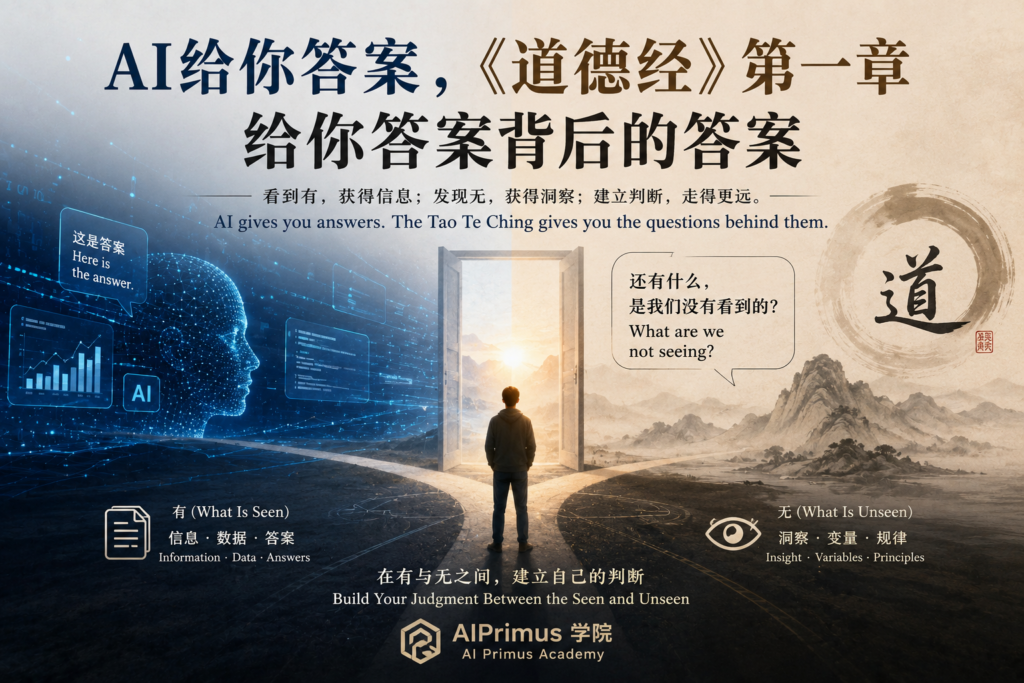
In the age of AI, information is becoming abundant. The scarce skill may be knowing what has not yet been seen.
Last month, an entrepreneur I know showed me his business plan.
It had been written with AI.
Fifty pages.
Tight logic.
Detailed data.
Beautiful charts.
Even the fundraising timeline was mapped out in impressive detail.
He was confident.
So he took it to meet an investor.
The investor spent five minutes flipping through the document, closed it, looked up, and asked one question:
“What is missing from this business plan?”
He froze.
The room went silent.
At that moment, he realized something important:
AI had helped him organize almost everything that could be seen, measured, described, and presented.
But it had not necessarily helped him identify what had not yet been seen.
And in many real-world decisions, that is where the real uncertainty lives.
More than two thousand years ago, Laozi opened the Tao Te Ching with a similar warning:
“The Tao that can be spoken is not the constant Tao;
the name that can be named is not the constant name.”
The passage is deeply philosophical, and it should not be reduced to a modern management formula.
But it offers a powerful lens for the AI age:
What you can see is rarely the whole story.
01 — When a Child’s Grades Fall, the Problem May Not Be the Grades
A child comes home with a lower score than usual.
What do many parents do?
More tutoring.
More exercises.
Less screen time.
More criticism.
All of these responses focus on the visible result:
the score.
But behind the score may be an entirely different set of factors.
The child may not be sleeping enough.
They may have lost interest in the subject.
They may be struggling with classmates.
Their learning method may no longer work.
Or they may simply be going through a new stage of development.
So instead of asking only:
“Why did you do so badly?”
A wiser question might be:
“What is happening behind the decline that we cannot see yet?”
That small change in the question can completely change the response.
Instead of trying to fix the score, you begin trying to understand the child.
This is one practical way to apply the idea of “the seen and the unseen” in everyday life.
Don’t only treat the outcome. Look for the variables behind the outcome.
02 — At Work, Don’t Confuse the Symptom with the Cause
Imagine a company’s sales suddenly decline.
The CEO says:
“The market is weak.”
Sales says:
“Customers are cutting budgets.”
Marketing says:
“Traffic has fallen.”
Finance says:
“We don’t have enough budget.”
Every explanation may sound reasonable.
But none of them necessarily explains the deeper problem.
Perhaps a competitor has quietly changed its strategy.
Perhaps customer needs have shifted.
Perhaps the company’s traditional distribution channels are becoming obsolete.
Perhaps the product has entered a different stage of its lifecycle.
Or perhaps the entire industry’s economics are changing.
The decline in sales is visible.
The forces causing that decline may not be.
This is why strong managers don’t stop at:
“How do we increase sales?”
They ask:
“Why are sales falling?”
And then:
“What factors are we currently not seeing?”
The difference between an average decision-maker and an exceptional one is often not intelligence.
It is the willingness to:
Ask one layer deeper.
03 — In Investing, Price Is Visible. Expectations Are Not.
Investors often mistake price for value.
A stock rises, and they conclude:
“The company is doing well.”
A stock falls, and they conclude:
“The company is in trouble.”
But price is an outcome.
Behind that price are many other variables:
Business model.
Competitive advantage.
Industry cycles.
Cash flow.
Technology.
Customer behavior.
Capital structure.
Management quality.
And, perhaps most importantly:
market expectations.
Consider an AI company.
Everyone may already know that its foundation model is powerful.
That is visible information.
If everyone knows it, however, the information may already be reflected in the valuation.
The more interesting questions are often:
Will inference costs continue to fall?
Will AI agents create a new business model?
Will customers remain loyal?
Can the company build a durable competitive moat?
Is its advantage temporary or structural?
These questions concern what has not yet fully materialized.
But there is an important distinction:
The unseen is not automatically valuable.
Something being invisible does not mean it exists.
Something being unknown does not mean it is an opportunity.
The unseen must be investigated and tested through:
data, evidence, logic, and observation.
That is the difference between genuine insight and speculation.
04 — The Best AI Users Ask One More Question After Getting the Answer
This may be where the first chapter of the Tao Te Ching becomes especially relevant to the AI era.
Most people use AI in a simple way:
Ask a question.
Get an answer.
Copy the answer.
Move on.
AI produces the visible output.
The process ends there.
But a more sophisticated AI user keeps going.
Ask:
What did you miss?
What assumptions does this conclusion depend on?
What variables have not been considered?
If this conclusion is wrong, where is it most likely to fail?
Now argue the opposite position.
Imagine asking AI:
“Should I change jobs?”
AI gives you a rational-looking recommendation.
Don’t stop there.
Ask:
“What factors have we not considered?”
It might bring up:
Family circumstances.
Industry cycles.
The opportunity cost of leaving.
The company’s financial condition.
Your long-term career trajectory.
The speed at which AI may reshape your role.
The cost of re-entering the industry later.
Now AI is doing something more valuable than simply giving you a recommendation.
It is helping you expand the frame of the problem.
AI is not making the decision for you.
It is helping you see the decision more completely.
And this leads to an important principle:
The best AI users are not necessarily the best prompt writers. They are the best question askers.
05 — AI Will Not Replace Your Thinking. It Will Amplify It.
AI can generate ten possible explanations.
But which one matters most?
Which sources are reliable?
Which assumptions are weak?
Which variables need verification?
Which conclusion should actually influence your decision?
These questions still require human judgment.
This is why the real value of AI is not simply:
“AI knows more than I do.”
It is:
“AI can help me think across more possibilities than I could alone.”
But there is an important caveat.
AI-generated information is not reality itself.
Data is not the world.
A model’s explanation is not necessarily the underlying cause.
An elegant answer can still be wrong.
In fact, one of the most dangerous features of generative AI is not that it cannot produce answers.
It is that it can produce answers that sound as if they are certain.
That makes human judgment more important, not less.
The future of AI will therefore require systems that can do more than retrieve knowledge.
They will need to become better at:
discovering variables,
connecting relationships,
forming hypotheses,
testing assumptions,
finding counterexamples,
and correcting themselves.
In other words:
The next generation of AI will not only need more knowledge. It will need better ways to discover what it does not yet know.
06 — Five Questions to Ask When You Face an Important Problem
You don’t need to become a philosopher to practice this.
The next time something important happens, ask yourself five questions.
1. What am I actually seeing?
Separate facts from emotions.
What happened?
What do I know?
What am I merely feeling?
2. What label have I put on it?
“This person is lazy.”
“My boss is against me.”
“The market is dead.”
“There is no opportunity.”
Are these facts?
Or are they interpretations?
3. What am I not seeing?
What information is missing?
What variables have I ignored?
What possibilities have I not considered?
4. What force is actually driving the outcome?
Don’t stop at:
“What happened?”
Ask:
“Why did it happen?”
Move from the visible result toward the underlying mechanism.
5. If I am wrong, where am I most likely wrong?
This may be the most important question of all.
A mature thinker does not only collect evidence that confirms their conclusion.
They actively search for evidence that could prove them wrong.
Because:
The most dangerous state is not ignorance.
It is believing you already know.
07 — AI Makes the “Seen” Explode. That Makes the “Unseen” More Valuable.
This may be one of the most important lessons to reconsider in the AI era.
For much of human history, one of our biggest problems was:
not enough information.
We had to spend years studying.
Reading books.
Learning from experts.
Accumulating knowledge.
AI is changing that equation.
Information is becoming easier to access.
Knowledge is becoming cheaper to produce.
Analysis is becoming faster.
Content is becoming easier to generate.
A task that once took several days may soon take several minutes.
So a new question emerges:
When knowledge becomes abundant, what becomes scarce?
Perhaps it is not more information.
Perhaps it is:
Better judgment.
And even more importantly:
The ability to discover questions that others have not yet asked.
08 — Real Cognitive Growth Is Not “Now I Know the Answer”
For a long time, learning followed a simple pattern:
I don’t know.
↓
I study.
↓
Now I know.
↓
Problem solved.
AI is changing this cycle.
Because AI can increasingly provide an answer before we have fully understood the problem.
So the more important questions become:
Why does this answer work?
What assumptions does it depend on?
What else could be true?
What have I overlooked?
What evidence would prove this conclusion wrong?
This is a shift:
from answer thinking to question thinking.
From:
“Tell me what this is.”
to:
“Show me what I might be missing.”
From:
“Give me a conclusion.”
to:
“Help me identify the variables behind the conclusion.”
From:
“AI, decide for me.”
to:
“AI, help me build a better judgment.”
That may become one of the most important cognitive skills of the AI era.
Conclusion — AI Gives You Answers. You Still Have to Search for What Comes Before Them.
The first chapter of the Tao Te Ching does not give us a simple formula.
It gives us a reason to pause.
The world is always larger than what we can immediately see.
Behind an outcome, there are causes.
Behind causes, there may be deeper mechanisms.
Behind an answer, there may be another question.
So genuine cognitive growth is not simply reaching the point where we can say:
“Now I know the answer.”
It is reaching the point where we can also say:
“I know what I might still be missing.”
This matters enormously in the AI age.
Because AI is making the “seen” increasingly abundant:
More information.
Faster answers.
Cheaper knowledge.
Easier analysis.
But precisely because the visible is becoming abundant, the ability to discover the invisible may become increasingly valuable.
So the next time you face an important decision, pause.
Ask:
What am I actually seeing?
What assumptions have I already made?
What am I not seeing?
What force is really driving this outcome?
And if I am wrong, where am I most likely wrong?
Then ask AI.
Don’t only ask:
“What is the answer?”
Ask:
“Based on what we currently know, what might we be missing?”
That changes the role of AI.
It is no longer merely an answer generator.
It becomes a tool for:
expanding your perspective,
discovering variables,
challenging assumptions,
finding counterarguments,
and strengthening judgment.
So perhaps the most useful way to think about the first chapter of the Tao Te Ching in the AI age is this:
What is visible gives us information.
What we discover beyond the visible gives us insight.
And between the two, we build judgment.
AI can give you more answers than ever before.
But the truly scarce skill may be the ability to ask the question that comes next:
“What are we still not seeing?”
Perhaps that is one of the most valuable questions the Tao Te Ching can bring into the age of artificial intelligence.
AIPrimus Academy
AI Thinking & Cognitive Transformation
AI × Tao Te Ching × Web3 × Future Civilization
Further Reading:
01.Why the Tao Te Ching May Contain the Most Advanced AI System Design Philosophy
02.Why the Most Valuable Asset in the Future Won’t Be Knowledge — But Cognitive Frameworks
03.AI Agent Era: Humanity Is Evolving from Executors to Designers