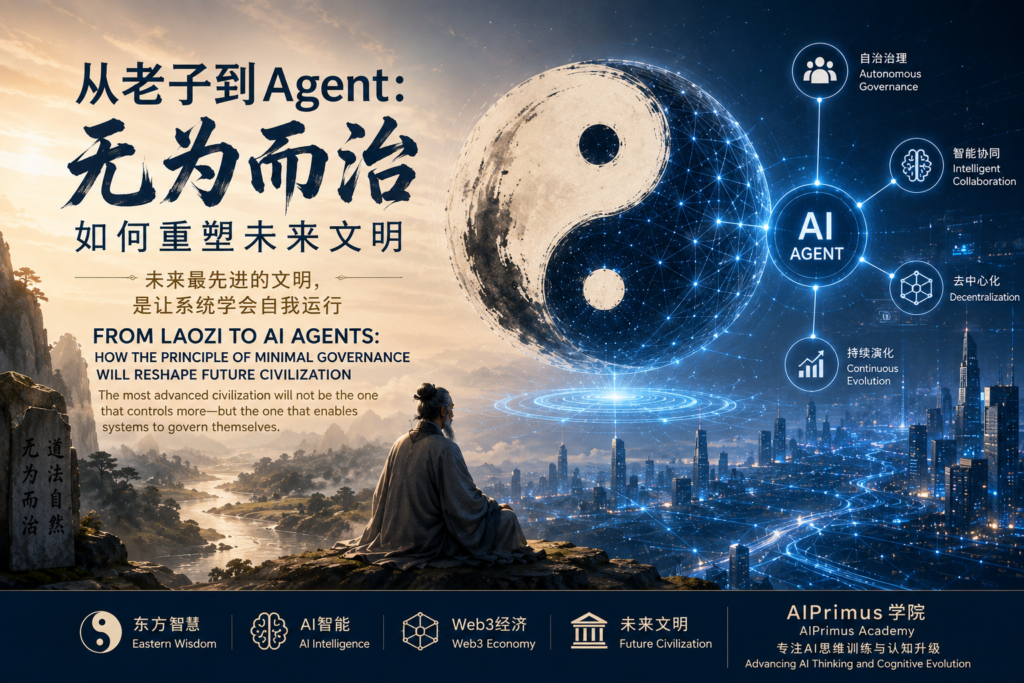
The Most Advanced Civilization Will Not Be the One That Controls More—But the One That Enables Systems to Govern Themselves
As artificial intelligence continues to evolve, most discussions remain focused on model capabilities: larger models, stronger reasoning, more autonomous AI agents, and increasingly capable robots. These developments are undoubtedly significant.
Yet from the perspective of civilization, they are not the most profound transformation.
The deeper shift lies elsewhere.
It is not that AI is becoming more intelligent.
It is that governance itself is becoming increasingly invisible.
Human civilization is gradually moving away from systems that depend on constant supervision and toward systems capable of organizing themselves.
This transition may become one of the defining characteristics of the AI era.
01. The Next Great Leap of Civilization Is Not Smarter AI—It Is Smarter Governance
Throughout history, every civilization has been shaped by the way it organizes human cooperation.
Agricultural civilizations relied on authority.
Industrial civilizations relied on hierarchy.
The Internet age relied on digital platforms.
The emerging AI civilization, however, is beginning to rely on autonomous systems.
Increasingly, complex problems will no longer require a centralized authority issuing continuous commands.
Instead, millions of autonomous nodes will coordinate through shared rules, continuous feedback, and distributed intelligence.
The center of civilization is shifting:
from control to governance.
And governance itself is evolving:
from managing people,
to designing systems,
that are capable of coordinating themselves.
In this emerging paradigm, human intervention moves earlier in the process—but becomes progressively smaller afterward.
Paradoxically, the highest level of governance is often characterized by the least visible governance.
02. Tao Te Ching: A Philosophy of Complex Systems Governance
Viewed through the lens of future civilization, the Tao Te Ching is far more than an ancient philosophical classic.
It can also be understood as one of humanity’s earliest explorations of Complex Systems Governance.
Laozi wrote:
“I practice non-interference, and the people transform themselves.”
For centuries, many have misunderstood Wu Wei (无为) as passivity or inaction.
In reality, it describes something far more sophisticated.
Wu Wei is the discipline of avoiding interventions that exceed a system’s natural capacity for self-organization.
Modern systems science expresses a remarkably similar principle:
Every unnecessary intervention creates new complexity.
The most resilient systems are not maintained through constant control.
They are sustained through well-designed structures.
Great governance is therefore not about creating more rules.
It is about designing better rules—and then allowing the system to operate naturally.
This is precisely what AIPrimus Academy describes as:
Minimal Governance.
03. Why AI Agents Naturally Evolve Toward Minimal Governance
The newest generation of AI Agents increasingly resembles living systems rather than traditional software.
Conventional software follows a rigid sequence:
Input → Execution → Output
Humans remain the controller throughout the process.
AI Agents operate differently.
Instead of managing every action, humans define objectives.
The system then autonomously:
- plans strategies,
- selects tools,
- collaborates with other agents,
- evaluates uncertainty,
- corrects mistakes,
- and completes tasks.
The workflow becomes:
Goal → Autonomous Planning → Multi-Agent Collaboration → Self-Correction → Execution
The more capable the Agent becomes, the less human supervision is required.
This represents a fundamental shift in the relationship between humans and intelligent systems.
Success no longer depends on controlling every step.
It depends on designing environments where intelligent behavior naturally emerges.
This idea closely echoes another insight from the Tao Te Ching:
“Assist the natural unfolding of all things, without excessive interference.”
The highest level of design is not making every decision.
It is creating conditions in which good decisions emerge continuously.
04. DAO, AI Agents, and Tao Te Ching Are Converging Toward a New Governance Paradigm
At first glance, Web3, AI, and the Tao Te Ching appear unrelated.
One belongs to blockchain.
One belongs to artificial intelligence.
One belongs to ancient philosophy.
Yet beneath the surface, all three are attempting to answer the same enduring question:
How can complex systems remain stable while continuously evolving?
DAO introduces:
Autonomous Governance
AI Agents introduce:
Autonomous Execution
The Tao Te Ching introduces:
Self-Organizing Order
Their shared objective is remarkably consistent.
Not stronger centralized authority—
but reduced dependence on centralized authority.
Future organizations may increasingly resemble this architecture:
Shared Vision
↓
Governance Protocols
↓
AI Agent Networks
↓
Distributed Collaboration
↓
Continuous Evolution
Leadership gradually shifts from commanding behavior to designing coordination.
The true competitive advantage of future organizations will not lie in who exercises greater control.
It will belong to those who can create governance structures that people willingly participate in—and that systems can continuously improve.
05. Minimal Governance Requires Better Design, Not Less Responsibility
Minimal Governance is often misunderstood as “doing less.”
The opposite is true.
Designing a self-governing system demands far greater sophistication than managing people directly.
It requires answering difficult questions before problems emerge:
- How will feedback circulate?
- How will errors be corrected automatically?
- How should incentives evolve?
- Where should authority be distributed?
- How is trust maintained over time?
The most effective leaders solve fewer problems each day.
Not because fewer problems exist—
but because the system has learned to solve them independently.
This reflects the evolution of management itself.
Industrial civilization focused on managing workers.
Information civilization focused on managing processes.
AI civilization focuses on designing rules.
Future civilization will focus on designing systems capable of governing themselves.
06. Civilization Is Entering the Age of Autonomous Systems
Viewed across history, civilization reveals a clear evolutionary trajectory:
- Agricultural Civilization: Authority
- Industrial Civilization: Organization
- Internet Civilization: Platforms
- AI Civilization: Intelligent Systems
- Future Civilization: Self-Organizing Networks
Tomorrow’s cities, enterprises, educational institutions, digital economies, and global communities may increasingly operate upon infrastructures such as:
- AI Agents
- DAO governance
- Smart Contracts
- Decentralized Identity (DID)
- Real-time feedback networks
- Autonomous governance protocols
The operating system of civilization will no longer be defined solely by governments, corporations, or institutions.
Instead, it will emerge from the interaction between:
Rules + Intelligence + Networks
In the decades ahead, the most valuable infrastructure may no longer be roads, buildings, or even the Internet itself.
It may be governance systems capable of continuously generating order from complexity.
07. Civilization Architects Will Become the Rarest Talent of the AI Era
AI is automating execution.
Agents are automating workflows.
DAO is decentralizing organizational coordination.
What, then, remains uniquely human?
Increasingly, the answer is:
Design.
The most valuable individuals of the future will not necessarily be those who:
- write the best code,
- manage the largest teams,
- or execute the fastest.
They will be those capable of:
- designing governance systems,
- architecting intelligent organizations,
- creating incentive structures,
- building adaptive institutions,
- and enabling long-term evolutionary resilience.
Industrial civilization educated laborers.
The Information Age cultivated knowledge workers.
The AI Age is producing systems designers.
The next stage of civilization may demand something even more ambitious:
Civilization Architects.
Their work extends beyond products, companies, or platforms.
They design the operating systems through which future civilizations evolve.
Conclusion | The Future Belongs to Civilizations That Govern Themselves
Across history, humanity has continuously sought more effective ways to organize cooperation.
From tribes to nations.
From factories to corporations.
From platforms to intelligent networks.
Every civilizational leap has ultimately been a transformation in governance.
Perhaps the greatest significance of artificial intelligence is not that machines are becoming more intelligent.
It is that systems themselves are becoming more autonomous.
This is also why the Tao Te Ching is becoming increasingly relevant in the AI era.
Its enduring wisdom offers more than philosophical reflection.
It provides a timeless methodology for governing complexity.
The most resilient systems are rarely those with the strongest control.
They are those built upon:
- minimal intervention,
- transparent rules,
- distributed collaboration,
- continuous adaptation,
- and self-organizing intelligence.
From Laozi to AI Agents, humanity is witnessing far more than another technological revolution.
We are witnessing a profound transformation in governance, organizational design, and civilization itself.
The defining competition of the AI era will not ultimately be about computational power, algorithms, or data.
It will be about who can design systems in which billions of humans and intelligent agents can continuously cooperate, adapt, and evolve together.
In the civilization to come, Minimal Governance may become the highest form of intelligence.
AIPrimus Academy
Advancing AI Thinking and Cognitive Evolution
Recommended Reading
- The True Wealth Logic of the AI Era: From Labor Income to System Income
https://aiprimus.ai/ai-system-income/ - Web3 Is Not a Financial Revolution, but the Technological Realization of Tao Te Ching Governance
https://aiprimus.ai/web3-tao-te-ching-governance/ - Why Cognitive Frameworks, Not Knowledge, Will Become Humanity’s Most Valuable Asset
https://aiprimus.ai/cognitive-framework-ai/ - The AI Agent Era: Humanity Is Evolving from Executors to Designers
https://aiprimus.ai/ai-agent-era-from-executors-to-designers/ - The AI Education Revolution: Why Traditional Schooling Is Becoming Obsolete
https://aiprimus.ai/ai-education-revolution/ - Prompt Is Not a Prompt—It Is the New Language of the Digital Age
https://aiprimus.ai/prompt-new-language-digital-age/ - Digital Twins: A New Asset Class in the Age of AI
https://aiprimus.ai/digital-twins-ai-new-asset-class/
About AIPrimus Academy
AIPrimus Academy is dedicated to advancing AI thinking and cognitive evolution through the integration of Artificial Intelligence, the Tao Te Ching, Web3, Systems Thinking, and Future Civilization.
Our mission is to help individuals become Cognitive Architects capable of designing intelligent systems for the AI era.
🌐 Official Website: