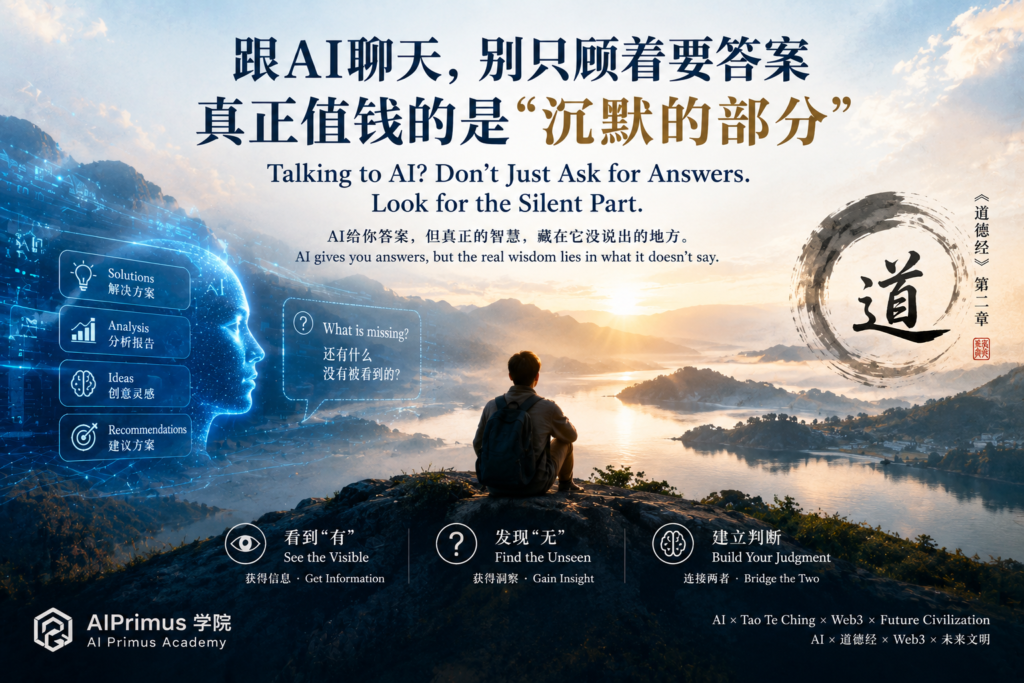
The more answers AI gives you, the more important it becomes to notice what it leaves unsaid.
A few days ago, a friend who creates content for a living complained to me.
“AI is getting too good,” he said.
“It can write scripts, generate headlines, and come up with content ideas. Give it three minutes, and everything is done.”
Then he paused.
“I’m starting to feel like AI’s spokesperson. I just move its answers from one place to another. The strange thing is, the more I use it, the less I feel like I’m thinking for myself.”
I asked him:
“Have you ever tried deliberately pausing after AI finishes answering?”
He looked confused.
“Pausing for what?”
I said:
“For the part AI didn’t say.”
He thought I was being philosophical for the sake of it.
But this is actually one of the most practical ideas hidden in the second chapter of the Tao Te Ching:
“You and non-you give birth to each other.”
Or, in the familiar Chinese formulation:
“有无相生。” — You and wu arise from each other.
The point is not that “something” and “nothing” are opposites.
They define and generate each other.
And in the age of AI, this idea becomes surprisingly practical:
The more “something” AI gives you, the more carefully you should look for the “nothing” behind it.
Not necessarily to find mistakes.
But to listen for what has not been said.
01 | Have You Noticed That AI Always Sounds Almost Too Complete?
Here is something worth noticing.
Ask AI a question, and the answer is usually remarkably complete.
There is an introduction.
Then several neatly organized points.
Then a conclusion.
The reasoning flows smoothly. The language sounds confident. Even the transitions seem perfectly placed.
Sometimes it is almost too complete.
There is hardly any hesitation.
But think about how humans actually think.
We pause.
We change our minds.
We contradict ourselves.
Sometimes we say:
“I’m not sure how to explain this.”
Or:
“Something about this doesn’t feel right, but I can’t quite put my finger on it.”
Those uncertain, unfinished moments are not necessarily signs of bad thinking.
Sometimes, they are where deeper thinking begins.
AI tends to fill those spaces.
It turns an unfinished thought into a finished paragraph.
It turns uncertainty into a conclusion.
It turns an open question into a structured answer.
And that creates a subtle problem:
When an answer fills the entire room, there is nowhere left for you to enter.
Imagine walking into a room packed from floor to ceiling with furniture.
Everything is there.
But there is nowhere to sit.
Nowhere to move.
Nowhere to rearrange anything.
That is what an overly complete AI answer can become.
So when you talk to AI, don’t rush into the answer.
Stand at the doorway for a moment.
Look around.
Ask yourself:
Where is the empty space?
02 | The Empty Space Is Where Your Thinking Begins
One of the most useful images associated with the idea of you and wu is the cup.
A cup is useful not simply because of its walls.
Its usefulness comes from the empty space inside.
The walls create the form.
The emptiness creates the function.
AI works in a similar way.
Everything AI gives you is the visible part:
information, options, explanations, strategies, predictions, and conclusions.
But what you actually need to think about may be hiding in the empty space.
Imagine an entrepreneur using AI for competitor research.
AI identifies seven major competitors.
Their funding, teams, products, positioning, and growth strategies are all laid out clearly.
But then ask:
Who isn’t on the list?
Why weren’t they included?
Was the information unavailable?
Were they considered irrelevant?
Or did the analysis simply inherit the assumptions built into the original data?
Now consider an HR manager using AI to screen resumes.
AI ranks the top ten candidates based on job requirements and keywords.
But what about the person whose resume is poorly written?
What about someone whose experience doesn’t match the keywords but whose actual abilities are exceptional?
AI can identify what is present.
But it may not automatically recognize what has been left out.
That leads to an important principle:
Your advantage may not come from getting more “answers” from AI. It may come from seeing what the answers leave outside the frame.
03 | The Best AI Users Ask Questions That Create Space
Most people ask AI questions because they want answers.
Better AI users sometimes ask questions that create space.
After asking AI to analyze something, try adding:
“What is one part of your answer that you are least certain about?”
That question changes the conversation.
You can also ask:
“If you had to leave something out of this analysis, what would it be?”
Or:
“What assumption in this conclusion is most vulnerable?”
Or:
“What is the strongest argument against your own conclusion?”
Or simply:
“What might we be missing?”
These questions are not primarily about getting more information.
They are about creating a gap inside the information.
A space where uncertainty can appear.
A space where assumptions can be examined.
A space where another possibility can emerge.
Think of it as making a small opening in an otherwise solid wall.
Through that opening, something different can enter.
And that “something different” may be where your real thinking begins.
04 | Answers Make You Feel Safe. Uncertainty Makes You Think.
Let’s be honest.
One reason we like AI so much is that it makes us feel safe.
Don’t know what to do?
Ask AI.
Can’t make a decision?
Ask AI.
Don’t feel like thinking?
Ask AI.
And AI almost always gives you something.
A structured response.
A reasonable explanation.
A list of options.
A recommendation.
You read it and think:
“Okay. I understand now.”
But sometimes that feeling of certainty is exactly where thinking stops.
You accept the answer.
And without realizing it, you also accept:
“I don’t need to ask anything else.”
But meaningful learning often begins precisely where certainty ends.
An answer gives you a place to stop.
An unanswered question gives you somewhere to go.
So when AI gives you an extremely polished answer, don’t automatically distrust the AI.
Instead, question your own reaction:
“Am I convinced because this is correct, or because it sounds complete?”
That is a very different question.
05 | Let AI Fill the Space. Your Job Is to Protect Some Empty Space.
This may be one of the most counterintuitive lessons of the AI era.
For decades, we trained ourselves to eliminate gaps.
More knowledge.
More information.
More skills.
More answers.
Now AI can fill those gaps faster than we ever could.
So perhaps the skill we need to develop is changing:
We no longer need to fill every empty space. We need to learn how to preserve some of it.
AI can give you one hundred possible solutions.
Your job is to ask:
“What perspective is missing from all one hundred?”
AI can give you ten pages of analysis.
Your job is to ask:
“What important question does this analysis never ask?”
AI can write a perfect opening for your article.
Your job is to ask:
“What if the entire framing is wrong?”
This is one modern way to understand you wu xiang sheng—the mutual arising of presence and absence.
AI’s “something” should not eliminate your “nothing.”
It should become your doorway into it.
Every AI answer can therefore become an opportunity to practice a different skill:
finding the space inside the answer.
That space may be where human judgment becomes most valuable.
06 | The Future Skill Is Not Knowing More. It Is Seeing What Is Missing.
For most of human history, knowledge was scarce.
If you knew more than other people, you had an advantage.
Then came the internet.
Information became abundant.
Now AI is taking another step.
Not only can we access information.
We can generate explanations, strategies, images, code, business plans, research summaries, and countless possible solutions almost instantly.
So the competitive advantage is moving again.
It may no longer be:
Who knows the most?
It may increasingly become:
Who notices what everyone else has overlooked?
Who can identify the missing assumption?
Who can see the blind spot?
Who can recognize that the question itself is poorly framed?
Who knows when an AI answer should be trusted—and when it should be challenged?
This is why AI literacy is not simply about learning better prompts.
It is about developing better judgment.
And judgment requires something AI cannot simply hand you:
the willingness to remain uncertain long enough to think.
07 | Five Questions to Ask After AI Gives You an Answer
The next time AI gives you an important answer, don’t stop there.
Ask five more questions.
1. What did you tell me?
Identify the visible.
What information, assumptions, and conclusions are actually present?
2. What did you not tell me?
Look for the unseen.
What information, perspectives, or possibilities might be missing?
3. What assumptions does this answer depend on?
Expose the conditions behind the conclusion.
4. When would this answer stop being true?
Find the boundary.
What changes would invalidate the recommendation?
5. What should I verify in the real world?
Return to reality.
What cannot be settled by AI alone?
These five questions are simple.
But they can fundamentally change the way you use AI.
You are no longer asking AI merely to give you answers.
You are using AI to explore:
what is known, what is unknown, what is assumed, what is missing, and what still needs to be tested.
The Real Power of AI May Begin Where Its Answer Ends
Laozi wrote:
“有无相生。”
You and wu arise from each other.
For thousands of years, this may have sounded like an abstract philosophical idea.
In the age of AI, it becomes surprisingly practical.
AI will become increasingly capable of speaking.
Increasingly capable of filling.
Increasingly capable of putting more and more “something” onto our screens.
And that creates a new human responsibility:
To notice the “nothing” inside all that “something.”
Not to compete with AI over who knows more.
Not to prove that AI is wrong.
But to pause after the answer and ask:
“What is missing here?”
AI may help fill the world with information.
Your job is to preserve enough empty space to think.
Because sometimes, the most valuable part of an answer is not what it says.
It is the space it leaves for you to discover.
AIPrimus Academy
AI Thinking & Cognitive Transformation
AI × Tao Te Ching × Web3 × Future Civilization
Related Reading:
01.Why the Tao Te Ching May Contain the Most Advanced AI System Design Philosophy
02.Why the Most Valuable Asset in the Future Won’t Be Knowledge — But Cognitive Frameworks
03.AI Gives You Answers. The Tao Te Ching Gives You the Questions Behind Them.