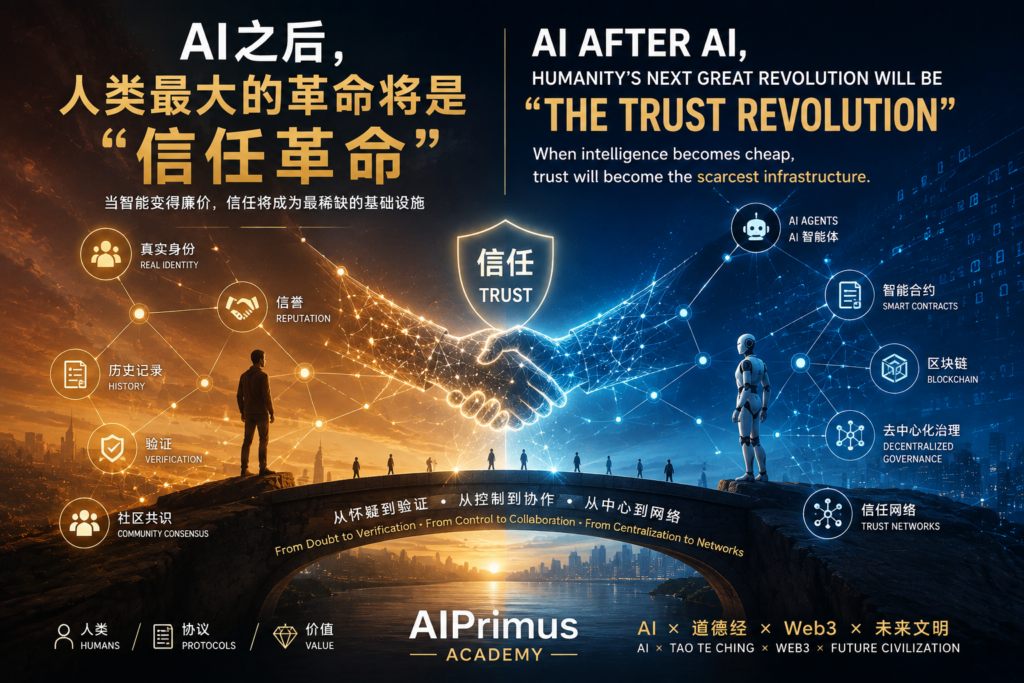
As Intelligence Becomes Cheap, What Becomes Truly Scarce Is No Longer Information — but Trust
For the past several decades, the internet has continuously reduced the cost of accessing information and connecting people.
Search engines made knowledge searchable.
Social networks made communication instantaneous.
Cloud computing made data accessible from almost anywhere.
Artificial intelligence is taking this transformation one step further.
Increasingly, anyone can access knowledge, generate content, analyze information, and even delegate tasks to intelligent systems at extremely low cost.
But as intelligence becomes cheaper, a new problem is emerging:
If we can no longer easily determine whether information, content, identities, and actions are authentic, what can we still trust?
A photograph may be AI-generated.
A video may be synthetically produced.
An article may not have been written by a human.
A social media account may not represent a real person.
A customer-service representative may be an AI agent.
A business partner may increasingly be represented by an AI system.
In the future, the entity on the other side of a transaction may not even be a single human being, but an entire intelligent system.
This leads to a question that may become more important than how intelligent machines can become:
How will we trust one another?
This may be the beginning of humanity’s next major transformation:
The Trust Revolution.
01 | The Internet Solved Connection. AI Is Amplifying the Trust Problem.
The internet solved the problem of connection.
It did not solve the problem of trust.
You can meet someone online without knowing who they really are.
You can see information without knowing whether it is true.
You can encounter a company without knowing whether it is reliable.
You can interact with an account without knowing whether there is a real person behind it.
For decades, society has relied on traditional trust mechanisms:
Identity documents.
Brands.
Institutions.
Degrees and credentials.
Media organizations.
Third-party verification.
Personal relationships.
These mechanisms help us answer a fundamental question:
Is this person, institution, or piece of information worth trusting?
AI is now changing the equation because it is simultaneously reducing two costs:
The cost of creation.
The cost of fabrication.
In the past, producing a professional video required a team, equipment, actors, editors, and significant resources.
Today, one person with AI can accomplish much of that work.
In the past, creating a professional article required research, writing, editing, and subject-matter expertise.
Today, AI can generate a convincing first version in minutes.
In the future, digital avatars may continuously represent a person’s appearance, knowledge, communication style, and even parts of their behavior.
This creates a fundamental problem:
When something that looks real can be manufactured cheaply, appearance itself stops being reliable evidence.
A photograph is no longer necessarily proof.
A video is no longer necessarily proof.
A voice is no longer necessarily proof.
An account is no longer necessarily proof of a real person.
Therefore:
Authenticity is becoming a scarce asset.
02 | The More Knowledge We Have, the More Valuable Credibility Becomes
AI is rapidly commoditizing knowledge.
It can search information, summarize research, generate reports, explain complex concepts, and simulate different expert perspectives.
Answers are becoming abundant.
Information is becoming abundant.
But something else is becoming increasingly scarce.
The value structure is moving upward:
Information → Judgment → Trust
When information becomes abundant, we do not necessarily need more information.
We need to know:
Which information deserves to be trusted?
When answers become abundant, we need to know:
Which answer should we act on?
And when AI agents become abundant, we need to know:
Which agent deserves to be authorized?
This means that one of the most important capabilities of the AI era may no longer be simply knowing more.
It may be:
Knowing What to Trust.
This shift also changes the meaning of valuable assets.
Data alone may not be enough.
What matters increasingly is the identity, history, context, and reputation behind the data.
A person’s digital identity may eventually include much more than a name, photograph, and account.
It may include:
What you have done.
What you have contributed.
Whether you have kept your commitments.
Who has worked with you.
How others evaluate your behavior.
And which networks recognize your reputation.
In other words:
Your behavioral history may become one of your most important digital assets.
Future wealth may therefore come not only from what you own, but also from:
How many networks trust you.
03 | From Proving “Who I Am” to Proving “What I Have Done”
Traditional identity systems primarily answer one question:
Who are you?
What is your name?
What is your identification number?
What credentials do you possess?
But the AI era introduces another question:
What have you actually done?
What have you created?
What have you contributed?
Which commitments have you fulfilled?
Have you demonstrated reliability over time?
This represents a fundamentally different model of identity.
Traditional identity:
Identity
The emerging model:
Identity + Reputation + History
And eventually:
Identity + Reputation + Capability + Contribution
Identity will no longer be only about proving who you are.
It will increasingly be about answering:
Why should anyone trust you?
This transformation could affect almost every major institution:
- Hiring
- Business partnerships
- Education
- Finance
- Content creation
- Professional services
- Organizational governance
The question will gradually shift from:
“Who are you?”
to:
“What does your history tell us about you?”
That is a very different foundation for trust.
04 | In the AI Agent Era, Trust Will Shift From “Trusting People” to “Trusting Systems”
Imagine a future in which your AI agent can:
Find suppliers.
Compare prices.
Negotiate contracts.
Purchase products.
Manage assets.
Schedule services.
And negotiate with other AI agents on your behalf.
The structure of trust changes immediately.
Today:
Human → Human
Tomorrow:
Human → Agent
And eventually:
Agent → Agent
The resulting architecture may look something like:
Trust → Protocol → Network
Humans will not need to control every step.
Instead, humans will increasingly define:
Objectives.
Boundaries.
Feedback mechanisms.
Incentives.
Rules.
But this creates a new requirement.
We will not only need to trust a person.
We will need to trust:
The behavior of the agent.
The system behind the agent.
The protocols governing the system.
This means trust can no longer depend primarily on intuition or personal familiarity.
It must increasingly become:
Verifiable.
05 | Trust Will No Longer Mean Simply Believing — It Will Mean Verifying
A mature trust system should not require us to blindly trust a platform, an expert, a company, or an AI model.
Instead, it should allow us to verify:
Identity.
Source.
History.
Rules.
Results.
This is:
Verifiable Trust.
It means I do not trust you simply because:
“I know you.”
I trust you because I can verify your history.
I do not trust a claim simply because:
“Everyone says it is true.”
I can examine the evidence.
I do not trust an AI agent simply because it says:
“The task has been completed.”
I can verify the outcome.
Identity, records, provenance, evidence, reputation, protocols, and feedback mechanisms will increasingly form something much larger:
Trust Infrastructure.
This may become one of the most important infrastructure layers of the AI economy.
06 | Web3 and Wu Wei: Designing Systems That Deserve to Be Trusted
When viewed through the lens of the AI era, the significance of Web3 may go beyond decentralization.
One of its deeper ideas is the possibility of shifting part of trust away from:
“Trust the central institution.”
toward:
“Verify the rules and historical records.”
Smart contracts can execute predefined rules.
Blockchains can record states and transactions.
Digital identities can connect participants.
On-chain reputation can preserve behavioral history.
DAOs can coordinate communities through shared protocols.
Web3 has certainly not solved every trust problem.
But it raises an important question:
Can some forms of trust be transformed into verification?
In such a system:
AI generates.
Networks connect.
Protocols constrain.
Verification mechanisms establish trust.
This also creates an interesting connection with Wu Wei in the Tao Te Ching.
Wu Wei should not be understood simply as “doing nothing.”
It can be understood as avoiding unnecessary intervention.
Not the absence of rules,
but the absence of excessive control.
Not the abandonment of governance,
but the creation of systems capable of operating with less constant intervention.
Not blind trust,
but the creation of systems that can continue to function, provide feedback, correct errors, and maintain order even when no one is watching every step.
Therefore:
The higher form of Wu Wei may be designing systems that deserve to be trusted.
This is not merely a philosophical idea.
It is increasingly becoming a principle of intelligent-system design.
07 | The Most Powerful Organizations of the Future May Be the Most Trusted Networks
As organizations evolve into intelligent networks, their competitive advantage may no longer depend primarily on:
Scale.
Capital.
Technology.
Data.
Or talent.
It may increasingly depend on whether they can build a high-quality:
Trust Network.
A mature intelligent network needs to answer fundamental questions:
Who participates?
Who contributes?
Who is responsible?
Who executes?
Who verifies?
What happens when something goes wrong?
How are errors corrected?
How are participants rewarded?
How are harmful behaviors penalized?
How can reputation be restored?
How can participants exit?
These questions may become the operating system of future organizations.
AI can make a system run faster.
But trust determines whether the system can run for the long term.
This leads to a critical principle:
The more powerful intelligence becomes, the more important trust mechanisms become.
When an AI agent begins managing money, executing contracts, negotiating on behalf of individuals, operating businesses, or participating in governance, humans cannot realistically inspect every action.
Instead, we need to determine:
Is this system worthy of authorization?
And the foundation of authorization is:
Trust.
08 | From Intelligent Networks to Trust Networks
In the previous AIPrimus article, we explored why industries may increasingly evolve from traditional value chains into intelligent networks.
But that raises a deeper question:
What allows an intelligent network to function?
The answer may not simply be:
More AI.
It may be:
Trust Networks.
An intelligent network without trust can produce more noise.
More agents do not automatically create more value.
More information does not automatically create more knowledge.
More connections do not automatically create better collaboration.
More automation can even create:
More automated errors.
This leads to an important and somewhat counterintuitive principle:
The more intelligent the system becomes, the more important its trust architecture becomes.
When AI can perform only simple tasks, humans can inspect its work step by step.
But when an AI agent can:
Manage capital.
Execute contracts.
Represent an individual.
Operate a company.
Control digital assets.
Participate in governance.
Or interact with physical systems,
we cannot manually inspect every decision.
We can only determine:
Whether it deserves to be authorized.
And authorization requires trust.
09 | The Most Important Question May No Longer Be “Who Is the Smartest?” but “Who Deserves to Be Authorized?”
This may become one of the most important shifts in human value during the AI era.
Historically, a person’s value was often associated with:
Intelligence.
Knowledge.
Education.
Skills.
Experience.
But AI can increasingly amplify all of these capabilities.
This creates a higher-order question:
Who deserves to be authorized?
Who should manage capital?
Who should access sensitive data?
Who should represent an organization?
Who should operate an AI agent?
Who should participate in governance?
Who should become a trusted node in a network?
Who should receive greater authority?
This means that one of the most valuable resources in the future may be:
Authorization.
And the foundation of authorization is:
Reputation and Trust.
A possible economic chain therefore emerges:
Trust → Reputation → Authorization → Value Creation
This may become one of the fundamental value flows of the AI economy.
10 | Humanity May Need to Upgrade Not Just Intelligence, but Trust Architecture
If AI continuously increases our ability to execute, the human challenge is not simply learning:
How to use AI.
How to write prompts.
How to deploy agents.
How to automate workflows.
A deeper challenge is:
How do we design systems that deserve to be trusted?
This requires a new class of capabilities:
Identity design.
Reputation design.
Permission design.
Incentive design.
Rule design.
Feedback design.
Governance design.
Verification design.
This connects directly to one of AIPrimus Academy’s broader themes:
From Executor to Designer.
The most valuable person of the future may not necessarily be:
“The person who can do the most.”
It may increasingly be:
The person who can design the most trustworthy system.
Conclusion | AI Determines How Far Intelligence Can Go. Trust Determines How Far It Will Be Allowed to Go.
Looking back at human civilization reveals a fascinating pattern.
Civilization was not built simply because humans became smarter.
It was built because humans learned how to trust one another.
Strangers became capable of cooperating.
Businesses became capable of trading.
Banks became capable of settling transactions.
Markets became capable of functioning.
Governments became capable of coordinating large populations.
The internet became capable of connecting the world.
Behind all of these systems lies some form of trust infrastructure.
AI is now taking us into a new phase.
In the past:
We trusted people.
Then:
We trusted institutions.
In the internet era:
We increasingly trusted platforms.
In the AI era:
We may increasingly need to trust systems.
And eventually, we may need to trust complex ecosystems composed of:
Humans + AI Agents + Protocols + Networks.
This means the most important question after AI may not simply be:
“What can machines do?”
It may be:
“Can we build sufficiently strong trust mechanisms to allow intelligent systems to collaborate safely?”
Because:
Intelligence determines what a system can do.
Trust determines what a system is allowed to do.
Governance determines what a system should do.
The next layer of civilization may therefore depend on whether these three can evolve together.
The Next Revolution May Not Be an Intelligence Revolution
Intelligence itself is becoming increasingly abundant.
What remains scarce is:
Trusted Identity.
Trusted Relationships.
Trusted Records.
Trusted Protocols.
Trusted Organizations.
Trusted Networks.
And ultimately:
A Trustworthy Civilization.
We created the internet to connect the world.
We are creating AI to bring intelligence into the world.
The next great revolution may be:
Teaching the world how to trust again.
This is:
The Trust Revolution.
And the most powerful organizations of the future may not be the organizations with the most AI.
They may be the organizations capable of allowing humans, AI agents, and intelligent networks to collaborate confidently without requiring every participant to know or trust every other participant personally.
Because when intelligence becomes abundant,
what becomes truly scarce
is:
Trust.
A Final Question from AIPrimus Academy
If you want to explore the trust infrastructure that is now beginning to emerge, join AIPrimus Academy — where we study the future before it becomes obvious.
AIPrimus Academy
AI × Tao Te Ching × Web3 × Future Civilization
Training AI Thinking. Upgrading Human Cognition.