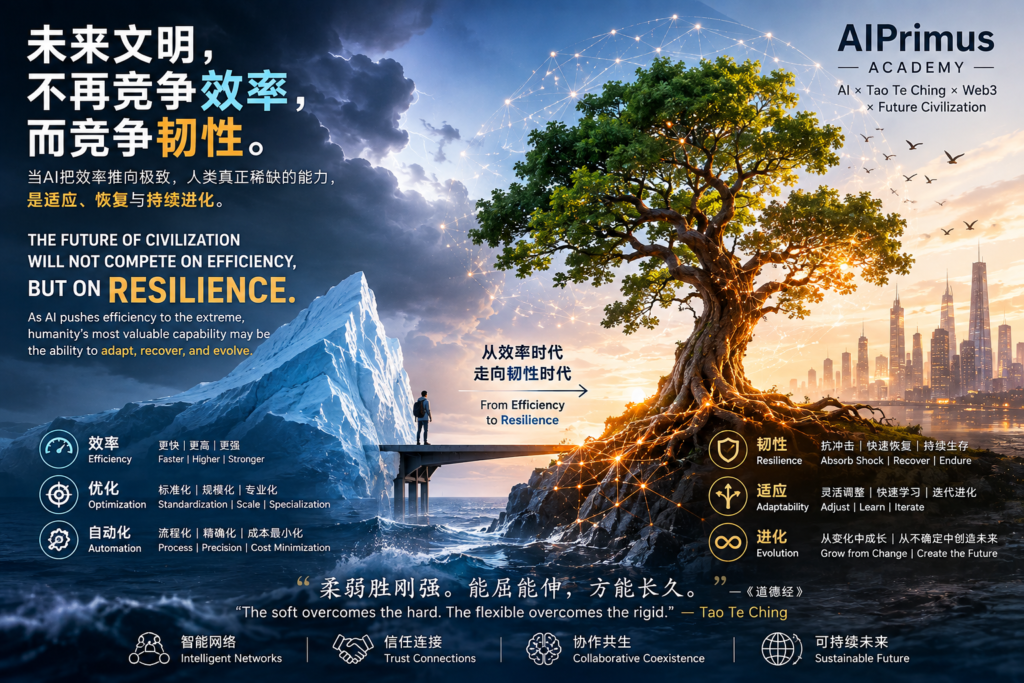
As AI pushes efficiency toward its limits, humanity’s most valuable capability may be the ability to survive, adapt, and evolve through uncertainty.
For the past two centuries, human civilization has pursued one dominant objective:
Faster. Higher. Stronger. More efficient.
The Industrial Revolution transformed production efficiency.
The assembly line transformed organizational efficiency.
The internet transformed information and communication.
And artificial intelligence is now pushing efficiency to an entirely new level.
Tasks that once required teams can increasingly be handled by one person working with AI agents.
Analysis that once took days can take minutes.
Knowledge, content, software, design, and execution are becoming dramatically cheaper.
So a fundamental question emerges:
When efficiency becomes increasingly abundant, what will civilization compete for next?
Perhaps not efficiency alone.
Perhaps:
Resilience.
01 | The Great Faith of Industrial Civilization: Efficiency
Modern industrial civilization was built around a powerful idea:
Break complex processes into standardized components, optimize each step, and make the entire system faster, cheaper, and more predictable.
Companies pursued:
Standardization.
Specialization.
Scale.
Automation.
Optimization.
The basic formula was simple:
Lower costs → Higher efficiency → Greater scale → Competitive advantage
And it worked extraordinarily well.
But efficiency has a hidden weakness.
The more aggressively a system is optimized, the more vulnerable it can become when conditions change.
Consider a highly optimized supply chain.
Minimal inventory.
Highly concentrated suppliers.
Precisely optimized logistics.
Almost no redundancy.
Under normal conditions, such a system can be incredibly efficient.
But what happens when a critical supplier shuts down?
When transportation is interrupted?
When technology fails?
When regulations suddenly change?
The system may struggle precisely because it was optimized for one particular environment.
This reveals a fundamental distinction:
Efficiency removes redundancy. Resilience preserves options.
Efficiency seeks the optimal path.
Resilience maintains alternative paths.
Efficiency asks:
How can we eliminate waste?
Resilience asks:
How can we continue functioning when something goes wrong?
02 | AI May Be Pushing the Era of Efficiency Competition Toward Its Limits
AI is rapidly turning execution capability into a commodity.
Writing.
Coding.
Research.
Data analysis.
Design.
Content creation.
Marketing.
Automation.
Increasingly, one person can accomplish what once required an entire team.
In the past, saying:
“I can do this faster than you.”
could create a meaningful competitive advantage.
In the future:
“My AI is faster than your AI.”
may not remain a durable advantage.
Models improve.
Tools spread.
Agents become easier to deploy.
Workflows become standardized.
Best practices diffuse rapidly.
AI may therefore be doing something historically unusual:
Turning efficiency itself into infrastructure.
Much like high-speed communication eventually became infrastructure rather than a competitive advantage, rapid analysis, generation, decision-making, and execution may become basic capabilities.
And when everyone becomes faster:
What becomes the next competitive advantage?
Perhaps:
The ability to endure.
And more importantly:
The ability to adapt.
03 | True Intelligence Is Not the Absence of Failure, but the Ability to Recover
Resilience does not mean stability.
Stability assumes:
The environment should remain relatively predictable.
Resilience assumes:
The environment will change, but the system can continue to function.
A resilient organization is not one that never makes mistakes.
It is one that does not lose its ability to recover and evolve after making them.
This distinction will become increasingly important in the AI era.
AI will make mistakes.
Markets will change.
Supply chains will break.
Technologies will become obsolete.
Customer behavior will shift.
Regulations will evolve.
Therefore, mature systems must be designed with:
Redundancy.
Alternative paths.
Feedback loops.
Error correction.
Exit mechanisms.
Recovery mechanisms.
The strongest system is not necessarily the one that says:
“Nothing will ever go wrong.”
It is the one that can say:
“Even when something goes wrong, we know how to keep moving.”
04 | The Essence of Resilience Is Preserving Options Under Uncertainty
Many people think resilience simply means having more resources.
Its deeper meaning is:
Optionality.
Consider a system with only one path forward.
It may be extremely efficient under normal conditions.
But if that path disappears, the entire system can fail.
A resilient system maintains alternatives.
It does not put every capability on one platform.
It does not depend entirely on one AI model.
It does not rely on a single distribution channel.
It does not concentrate all critical knowledge in one person.
It does not assume that today’s environment will remain tomorrow’s environment.
The principle is simple:
Resilience means preserving enough options to remain adaptable when circumstances change.
This may become one of the most important principles for designing future organizations.
05 | From Optimized Systems to Adaptive Systems
Industrial civilization focused on:
Optimization
Find the best answer.
Find the most efficient process.
Find the optimal structure.
The AI era may require something different:
Adaptation
Build systems capable of continuously finding new answers.
In the past:
Predict the future.
Increasingly:
Build systems that can respond when the prediction is wrong.
In the past:
Design a stable process.
Increasingly:
Design a process that can redesign itself.
In the past:
Optimize for a known environment.
Increasingly:
Prepare for an environment that cannot be fully known.
This leads to an important principle:
The strongest system may not be the one that predicts the future most accurately, but the one that can correct itself most quickly.
06 | The Future May Need Intelligent Resilience
Much of the public imagination around AI focuses on one question:
How intelligent can a machine become?
But from a systems perspective, another question may be even more important:
How resilient can an intelligent system become?
Imagine a network composed of multiple AI agents.
Different agents perform different functions.
Multiple data sources cross-check one another.
Critical decisions have redundancy.
Different models can replace one another.
Failures can be isolated.
Feedback continuously flows through the system.
Local failures do not necessarily become systemic failures.
This is:
Intelligent Resilience.
The value of AI is no longer simply making one node smarter.
It is making the entire network:
More adaptive.
More distributed.
More self-correcting.
More resilient.
This naturally extends the idea of the Intelligent Network.Why Every Industry Will Eventually Become an “Intelligent Network”
The next stage may be:
An intelligent network capable of learning and recovering as a system.
07 | From Efficiency to Resilience — and Then to Evolution
There is a deeper progression here.
Efficiency asks:
Who can do it faster?
Resilience asks:
Who can survive longer?
But the next question may be even more important:
Who can evolve faster?
When a system experiences a shock, there are at least three possible outcomes.
It collapses.
It returns to its previous state.
Or:
It becomes better than it was before.
This is the highest form of resilience.
Not:
Return to Normal.
But:
Adapt and Evolve.
A resilient system does not simply recover from disruption.
It learns from disruption.
It converts mistakes into information.
It converts crises into redesign.
It converts uncertainty into new possibilities.
The ultimate goal is therefore not permanent stability.
It is:
Sustainable Evolution.
08 | A Lesson from the Tao Te Ching: Flexibility Can Be Stronger Than Rigidity
The Tao Te Ching offers an interesting perspective on resilience.
One of its central insights is expressed through the principle:
“Reversal is the movement of the Tao; weakness is the method of the Tao.”
Human beings often imagine progress as a straight line:
More.
Faster.
Bigger.
Stronger.
But nature does not operate in a perfectly linear way.
There are cycles.
Expansion and contraction.
Growth and renewal.
Change and adaptation.
Recovery and transformation.
A system that survives for a long time is not necessarily the system that maintains maximum intensity forever.
It may be the system capable of adapting to changing conditions.
This gives us another way to understand resilience:
Flexibility can outperform rigidity.
Adaptation can outperform resistance.
Recovery can matter more than perfection.
From this perspective, resilience is not a rejection of efficiency.
It is:
The missing dimension that civilization must add after the age of optimization.
09 | The Future Civilization May Compete on Adaptive Capacity
For two centuries, we optimized for efficiency.
The internet accelerated that process.
AI is now pushing it toward its limits.
As knowledge, content, execution, and intelligence become increasingly abundant, speed itself may no longer be sufficient to create lasting advantage.
The future will increasingly ask different questions:
Can an organization continue creating value during disruption?
Can a person transfer their skills across industries?
Can an AI network continue functioning when one model fails?
Can a supply chain quickly find alternatives?
Can a company redesign itself when its original business model disappears?
Can civilization learn from crises instead of merely recovering from them?
These are questions of:
Resilience.
But beyond resilience lies something even more important:
Adaptability.
And beyond adaptability:
Evolution.
Conclusion | The Future Will Not Belong Simply to Those Who Move Fastest
For the past two centuries, humanity competed on efficiency.
The internet accelerated the process.
AI is now taking it toward a new extreme.
Knowledge is becoming abundant.
Content is becoming abundant.
Execution is becoming abundant.
Intelligence itself is becoming increasingly accessible.
When everyone can become faster, speed alone becomes a weaker long-term advantage.
The critical questions will become:
Can a system absorb shocks?
Can an organization continue creating value through uncertainty?
Can an individual continuously transfer and rebuild their capabilities?
Can an intelligent network continue operating when individual nodes fail?
Can civilization update itself after a crisis?
That is resilience.
But true resilience is not about never failing.
It is:
Recovering after failure.
Learning after recovery.
Evolving after learning.
Ultimately:
Turning uncertainty itself into fuel for evolution.
Perhaps the greatest transformation brought by AI will not be that machines become more efficient than humans.
It will be that humanity begins to redefine what strength actually means.
The old definition of strength was:
Faster.
Bigger.
Stronger.
The emerging definition may be:
More adaptable.
More recoverable.
More connected.
More capable of learning.
More capable of evolving.
Therefore:
The future of civilization will not be defined by who is the most efficient, but by who is the most resilient.
And beyond resilience lies an even deeper question:
Who can continue evolving in a world that never stops changing?
Perhaps that is the real competition of the AI era.
AIPrimus Academy
AI × Tao Te Ching × Web3 × Future Civilization
From the Age of Efficiency to the Age of Resilience.
Training AI Thinking. Upgrading Human Cognition.