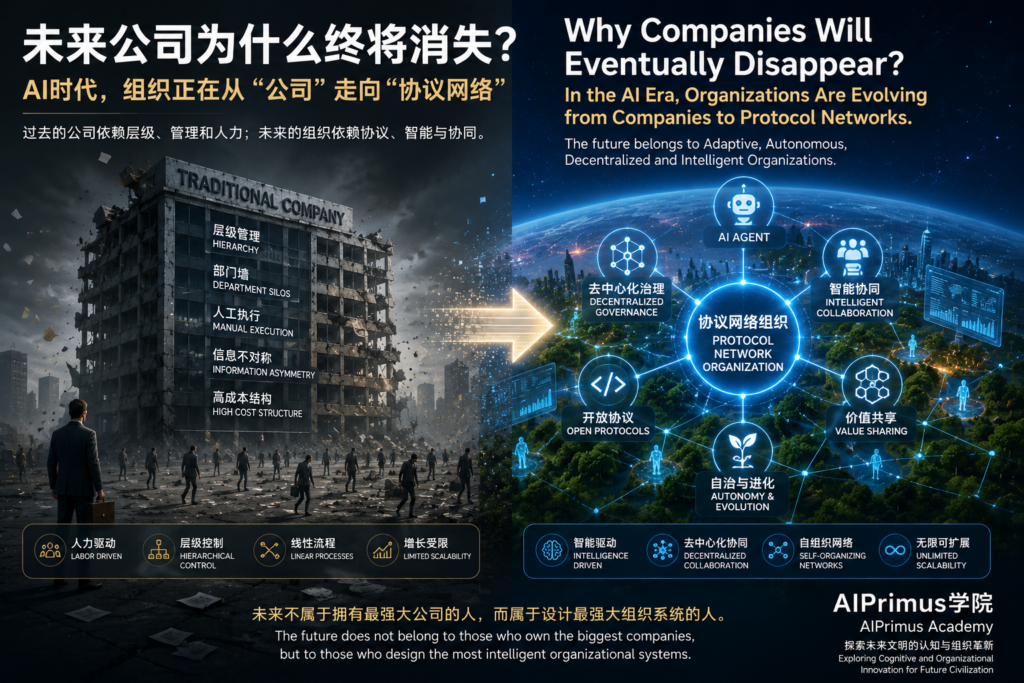
Why the Greatest Transformation of the AI Era Is Not Technology, but Organization
AIPrimus Academy | Future Civilization Institute
Introduction | The Future Is Not Company-Free—It Is Company-Optional
For more than two centuries, the company has been the dominant organizational unit of modern civilization.
Since the Industrial Revolution, factories, corporations, employees, management hierarchies, and corporate governance have shaped how society creates value.
We have grown accustomed to one assumption:
If you want to build something meaningful, you start a company.
Artificial Intelligence is beginning to challenge that assumption.
The most profound disruption of the coming decades may not be the disappearance of businesses, but the decline of the company as the default organizational model.
As AI, autonomous agents, Web3, and globally distributed collaboration converge, humanity is witnessing the emergence of a fundamentally different way of organizing work.
It is increasingly possible to create value without relying on a traditional corporation.
This is not simply a more efficient company.
It represents the birth of a new organizational paradigm—and perhaps a new stage of civilization itself.
1. Companies Were Designed for the Industrial Age
From the perspective of human history, the modern corporation is a surprisingly recent invention.
Agricultural civilizations relied on families, clans, kingdoms, and local communities.
The Industrial Age introduced entirely new challenges.
Large-scale manufacturing required:
- Massive capital investment
- Concentrated labor
- Centralized management
- Standardized coordination
The corporation emerged as the optimal solution.
Its true purpose was never simply to generate profits.
Its deeper function was to solve one fundamental problem:
How can millions of strangers coordinate their efforts efficiently?
A company is, in essence, a coordination protocol.
It is not merely a commercial entity—it is an organizational technology.
2. AI Is Eroding the Foundations of the Corporation
The rise of AI is often associated with automation and productivity.
But its deeper impact lies elsewhere.
AI is gradually dissolving the three traditional advantages that justified large corporations.
First, labor.
Organizations once depended on large workforces.
Today, intelligent agents increasingly perform execution, analysis, content creation, research, customer service, and software development.
Second, management.
Managers traditionally coordinated workflows and communication.
Now autonomous workflows and multi-agent systems can coordinate complex processes with minimal human intervention.
Third, knowledge.
Companies once accumulated competitive advantages through proprietary expertise.
Today, AI provides near-instant access to global knowledge at unprecedented scale.
As these three pillars weaken, corporations begin to evolve from collections of employees into ecosystems composed of:
- Rules
- Algorithms
- Autonomous Agents
- Distributed Networks
The organization itself becomes increasingly autonomous.
3. Organizations Are Evolving from Hierarchies to Networks
Industrial organizations resemble pyramids.
CEO

↓

Executives

↓

Managers

↓

Employees
Information flows upward.
Instructions flow downward.
This architecture made sense in a world where communication was slow and information was scarce.
AI changes both assumptions.
Real-time intelligence allows information to flow instantly.
Autonomous systems distribute work dynamically.
Decision-making becomes increasingly decentralized.
The emerging organizational structure looks very different:
Human Designers

↓

AI Agent Networks

↓

Dynamic Collaboration

↓

Continuous Evolution
Instead of rigid hierarchies, organizations begin to resemble living networks.
Their strength comes not from centralized authority, but from continuous coordination.
4. DAO Is Not an Upgrade to the Corporation—It Is an Alternative
Many people associate DAOs (Decentralized Autonomous Organizations) exclusively with blockchain technology.
In reality, they address a far more fundamental question:
Can an organization function without traditional management?
Industrial corporations answer:
“No.”
DAOs answer:
“Yes.”
Provided there is:
- Shared purpose
- Transparent governance
- Incentive alignment
- Open protocols
- Continuous feedback
Coordination becomes possible without centralized authority.
The revolutionary aspect of DAOs is not cryptocurrency.
It is the realization that an organization itself can become programmable.
In the future, companies may increasingly resemble software.
Governance becomes protocol.
Coordination becomes network architecture.
Organizations become living systems.
5. The Tao Te Ching Proposed a Different Organizational Philosophy 2,500 Years Ago
Viewed through the lens of systems thinking, the Tao Te Ching reads less like an ancient philosophical text and more like a treatise on complex systems governance.
Laozi wrote:
“The highest ruler is barely known by the people.”
This is not a call for passive leadership.
It is a principle of elegant system design.
The highest form of governance is one in which order emerges naturally.
Rather than relying on constant intervention, it depends on:
- Clear structures
- Healthy feedback loops
- Appropriate incentives
- Minimal necessary control
Modern systems science expresses a remarkably similar insight:
Every unnecessary intervention creates new complexity.
Great governance is not about adding more rules.
It is about designing systems that require fewer rules.
This is precisely what AI civilization increasingly demands.
6. The Future Belongs to Lightweight Organizations
For decades, business strategy revolved around scale.
Larger organizations meant:
- Greater efficiency
- Lower costs
- Stronger competitive advantages
The AI era introduces a different equation.
Smaller organizations can now outperform larger ones.
A compact team equipped with:
- AI Agents
- Autonomous workflows
- Global freelance talent
- Web3 incentive systems
- Cloud-native infrastructure
may create more value than corporations employing hundreds of people.
Competitive advantage shifts from organizational size to organizational intelligence.
The central question becomes:
How well is the system designed?
Competition is moving beyond people.
It is becoming competition between systems.
7. Future Civilization Will Be Built on Protocol Organizations
Looking further ahead, human organization may evolve through successive stages:
Agricultural Civilization
Family-based organization
↓
Industrial Civilization
Corporations
↓
Internet Civilization
Platforms
↓
AI Civilization
Autonomous Agent Networks
↓
Future Civilization
Protocol Organizations
Protocol organizations operate through:
- Open governance
- Autonomous execution
- Distributed collaboration
- Continuous adaptation
- Evolutionary coordination
Participation becomes voluntary.
Boundaries become fluid.
Organizations are no longer defined by physical offices or legal structures.
They are defined by shared protocols.
In the future, the most important question may no longer be:
Which company do you work for?
Instead, it may become:
Which value networks do you contribute to?
Conclusion | The Greatest Organizations of the Future May No Longer Be Companies
Over the past three centuries, corporations powered industrial civilization.
Over the next three decades, civilization may witness another organizational transformation.
AI is automating execution.
Autonomous agents are coordinating operations.
Web3 is reinventing governance.
Protocols are replacing institutions.
The result is a new organizational possibility:
Creating global value without relying on traditional corporate structures.
The defining challenge of the future will no longer be:
How do we manage a company?
Instead, it will be:
How do we design systems capable of continuous coordination, autonomous evolution, and self-governance?
The ultimate competition of future civilization will not be determined by:
- Company size
- Number of employees
- Capital assets
It will be determined by who can build organizational systems in which humans, AI, and intelligent networks collaborate seamlessly to create lasting value.
Perhaps companies themselves will not disappear.
What will disappear is our current definition of what a company is.
AIPrimus Academy | Future Civilization Institute
Exploring AI × Tao Te Ching × Web3 × Future Civilization
Dedicated to AI Thinking, Systems Philosophy, Cognitive Architecture, and the Design of Future Civilization.
Recommended Reading:
Why the Tao Te Ching May Contain the Most Advanced AI System Design Philosophy
The Future of Wealth: Why AI Is Shifting Income From Labor to Systems
Why the Most Valuable Asset in the Future Won’t Be Knowledge — But Cognitive Frameworks
AI Agent Era: Humanity Is Evolving from Executors to Designers
About AIPrimus Academy
AIPrimus Academy (Future Civilization Institute) explores the intersection of Artificial Intelligence, Tao Te Ching, Web3, Systems Thinking, and Future Civilization.
We are dedicated to advancing AI thinking, cognitive architecture, organizational innovation, and the design of future civilization.
Official Website