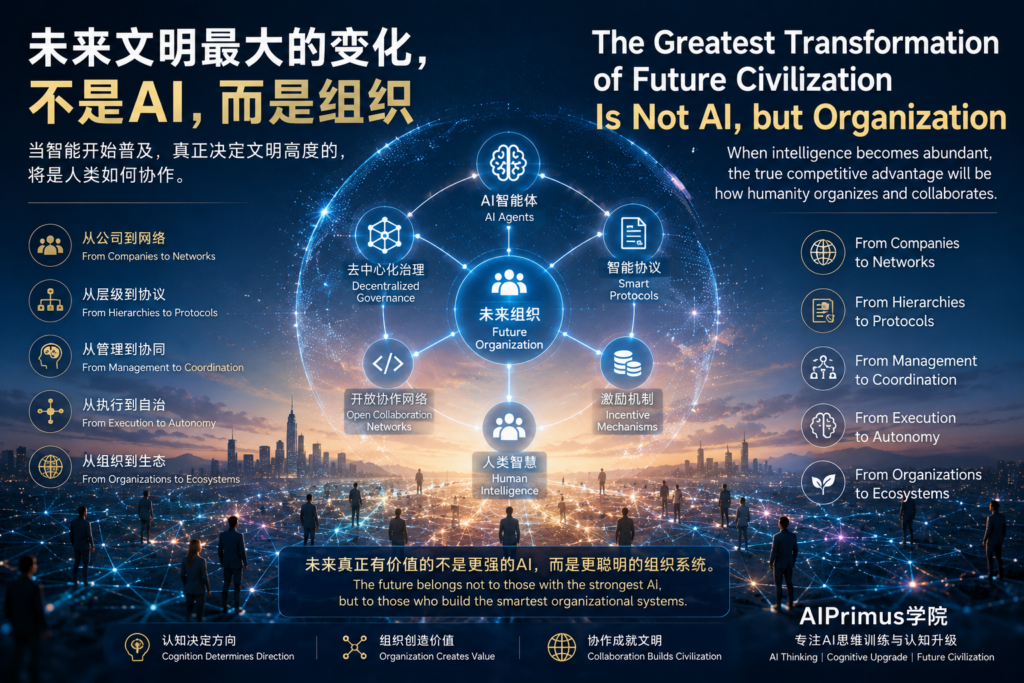
When Intelligence Becomes Abundant, the True Competitive Advantage Will Be How Humanity Organizes It
Over the past few years, nearly every conversation about the future has revolved around artificial intelligence.
Larger language models. More powerful computing. Smarter AI agents. More capable humanoid robots.
It is easy to conclude that AI itself is the defining force of the next civilization.
Yet when viewed through the longer arc of history, a different pattern emerges.
Technology rarely changes civilization on its own. What truly transforms civilization is the way technology reshapes how people organize and collaborate.
The steam engine did not create industrial civilization by itself. The factory system did.
The Internet did not create the Information Age alone. Global digital networks did.
Likewise, AI will not define the future simply because machines become more intelligent.
The defining question of the AI era is how intelligence reorganizes human society.
01 | Civilization Evolves Through Better Organization, Not Smarter Individuals
Human history reveals an overlooked truth.
Civilizations do not advance merely because individuals become more intelligent.
They advance because larger groups of people become capable of coordinating their efforts more effectively.
Agricultural civilization enabled strangers to cooperate in permanent settlements.
Industrial civilization organized millions into factories and enterprises.
The Internet connected billions through shared information networks.
Each leap in civilization represented an evolution in organizational capability.
Economist Ronald Coase argued that firms exist because they reduce transaction costs.
Artificial intelligence is now reducing something even more fundamental:
- communication costs;
- decision-making costs;
- coordination costs;
- execution costs.
This raises an extraordinary question:
If the cost of organizing approaches zero, what will organizations become?
02 | The Largest Companies of the Future May No Longer Look Like Companies
Traditional organizations have always grown through familiar means:
- hiring more employees;
- adding more managers;
- building increasingly complex operational structures.
Growth meant expansion.
But AI is beginning to rewrite this equation.
Tasks once requiring entire departments are increasingly handled by autonomous agents.
Research can be performed by Research Agents.
Content creation by Content Agents.
Customer support by Service Agents.
Marketing by Marketing Agents.
Financial operations by Finance Agents.
In the near future, a company with only a few dozen human employees may coordinate tens of thousands of AI agents operating continuously across multiple domains.
Organizational scale will continue to grow.
Human headcount may not.
Companies are evolving from labor-intensive organizations into intelligence-intensive organizations.
The most valuable enterprises of tomorrow may not employ the most people.
They may simply orchestrate intelligence more effectively than anyone else.
03 | Organizations Will Be Governed by Protocols Rather Than Hierarchies
Industrial organizations resembled pyramids.
Commands flowed downward.
Information flowed upward.
Decision-making depended on multiple management layers.
This model excelled in stable environments.
It struggles in rapidly changing ones.
AI introduces an entirely different organizational paradigm.
Increasingly, tasks no longer require constant managerial approval.
Instead, autonomous systems coordinate themselves within predefined rules.
As a result, one of the most valuable assets of future organizations will no longer be bureaucracy.
It will be protocols.
Protocols are fundamentally different from commands.
A command instructs.
A protocol enables.
The Internet operates through TCP/IP protocols.
Blockchain ecosystems rely on consensus protocols.
AI agents increasingly collaborate through standardized communication protocols.
In the future, organizational competitiveness will depend less on management structures and more on the quality of the protocols that enable continuous collaboration and adaptation.
04 | Leadership Is Shifting from Managing People to Coordinating Intelligence
Industrial leaders managed workers.
The Information Age managed knowledge workers.
The AI era introduces an entirely new challenge.
Future leaders will coordinate not only people, but also:
- AI agents;
- autonomous workflows;
- digital twins;
- intelligent knowledge systems;
- external AI models.
Leadership itself is undergoing a profound transformation.
Rather than assigning tasks, future leaders will increasingly design relationships between humans and intelligent systems.
Which decisions require human judgment?
Which should be delegated to AI?
When should intervention occur?
When should autonomous systems operate independently?
The strongest organizations will not maximize human effort.
They will maximize the contribution of every form of intelligence.
05 | Tao Te Ching Offers a Timeless Philosophy of Organization
Many readers approach the Tao Te Ching as a book about personal cultivation.
Viewed through the lens of systems thinking, however, it becomes something more profound:
a philosophy of organizing complexity.
Laozi famously wrote:
“Governing a great nation is like cooking a small fish.”
The wisdom is remarkably modern.
Exceptional governance is not achieved by increasing control.
It is achieved by establishing sound principles while allowing systems to evolve naturally.
Today, complexity science reaches a remarkably similar conclusion.
Healthy systems share three characteristics:
- clear rules;
- distributed trust;
- strong self-organization.
These principles resonate with modern research in complex adaptive systems, decentralized networks, and autonomous AI architectures.
The organizations of the future will succeed not because they exercise greater control.
They will succeed because they require less.
06 | Web3 Is Redefining What an Organization Can Be
Traditionally, joining an organization meant joining a company.
Tomorrow, it may simply mean joining a network.
Decentralized Autonomous Organizations (DAOs) challenge one of management’s oldest assumptions:
Can organizations function without centralized authority?
Increasingly, the answer appears to be yes.
Shared missions coordinate participation.
Smart contracts execute agreed-upon rules.
Tokens align incentives.
AI agents perform execution.
The result is an entirely new organizational model.
Organizations without headquarters.
Without traditional departments.
Without rigid chains of command.
Yet capable of creating sustained economic and social value.
As AI and Web3 continue to converge, the boundaries between companies, communities, open-source ecosystems, and learning networks will gradually disappear.
Organizations are evolving from closed institutions into living ecosystems.
07 | The Next Great Competition Will Be the Ability to Organize Intelligence
Every era competes around a different strategic resource.
Industrial civilization competed for capital.
The Information Age competed for talent.
The digital economy competed for data.
The AI civilization may compete for something even more fundamental:
The ability to organize intelligence.
Intelligence now extends far beyond human expertise.
It includes:
- human creativity;
- AI agent networks;
- open-source communities;
- distributed knowledge;
- autonomous systems.
The world’s most influential organizations will not simply accumulate resources.
They will become platforms that connect, amplify, and coordinate every available form of intelligence.
Future leaders will increasingly resemble ecosystem architects.
They will design relationships rather than workflows.
Connections rather than departments.
Evolution rather than control.
Conclusion | The Greatest Innovation of the AI Era Is Not Smarter Machines—It Is Smarter Organizations
Many believe artificial intelligence represents the defining revolution of our time.
History suggests something deeper.
Every technological revolution ultimately becomes an organizational revolution.
Over the coming decades, humanity may witness an extraordinary transition:
From companies to networks.
From management to protocols.
From hierarchy to coordination.
From execution to autonomy.
From organizational efficiency to organizational intelligence.
AI is the catalyst.
Organization is the transformation.
When intelligence becomes universally accessible, civilization’s greatest competitive advantage will no longer be who possesses the most knowledge.
It will be who can organize intelligence most effectively.
Perhaps the most important infrastructure of future civilization will no longer be energy, transportation, or even the Internet.
It will be organizational systems capable of continuously learning, coordinating, and evolving.
Only when organizations themselves become intelligent will civilization truly enter its next chapter.
AIPrimus Academy
Focused on AI Thinking Training and Cognitive Advancement
Related Reading
- Wealth in the AI Era: From Labor Income to System-Based Income
- Web3 Is Not a Financial Revolution, but a Technological Implementation of Tao Te Ching Governance
- Why the Most Valuable Asset in the AI Era Is Not Knowledge, but Cognitive Frameworks
- The AI Agent Era: Humanity Is Evolving from Executors to Designers
- The AI Education Revolution: Why What Schools Teach Is Becoming Obsolete
- Prompt Is Not a Prompt—It Is the New Language of the Digital Age
- Digital Twins: A New Asset Class in the AI Era
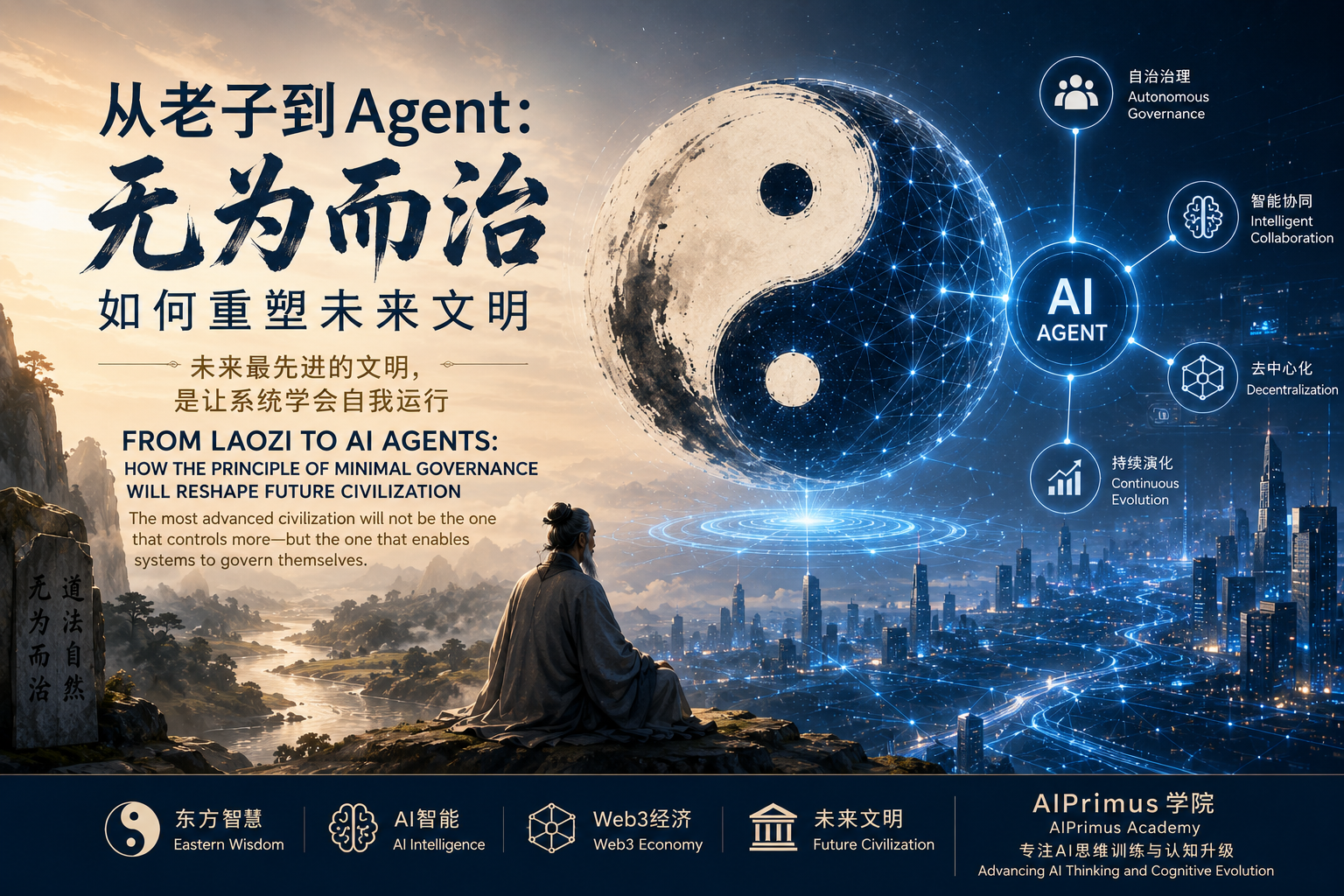
- From Laozi to AI Agents: How Minimal Governance Will Reshape Future Civilization
Pingback: The Future of Wealth Is Not Ownership, but Connection | AI, Web3 & Future Civilization