Why the Next Great Asset in the AI Era Will Be Networks, Not Possessions
When AI democratizes production and Web3 redefines ownership, the most valuable resource will no longer be what you own—but what you can connect.
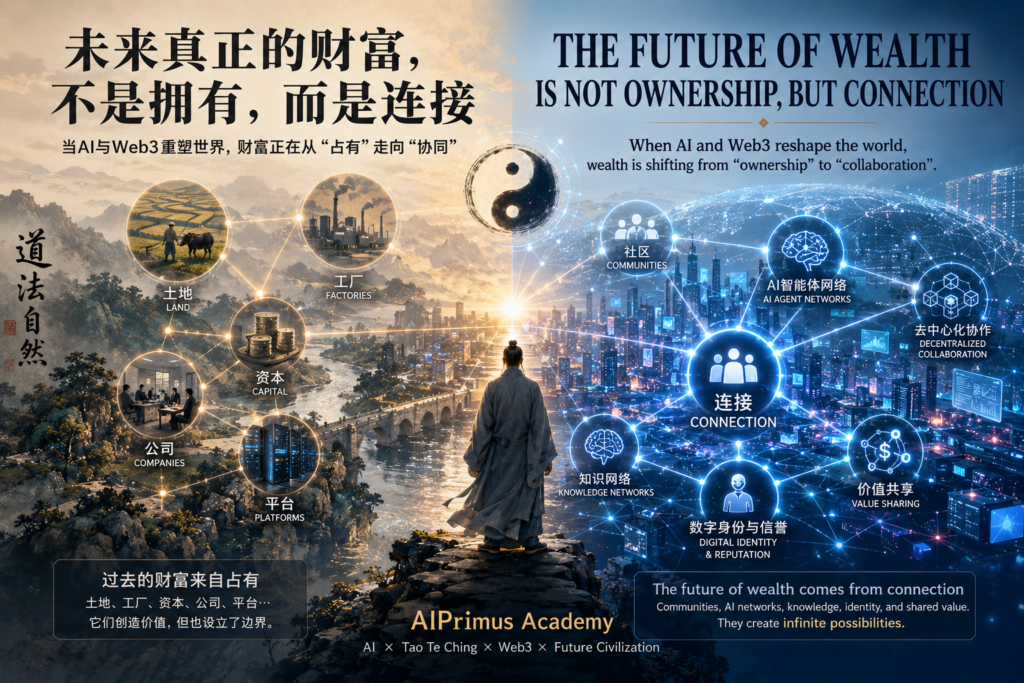
Introduction | The Meaning of Wealth Is Quietly Changing
For centuries, humanity has measured wealth through ownership.
In agricultural civilizations, wealth meant owning land.
In industrial societies, it meant owning factories and capital.
In the Internet era, it expanded to owning platforms, users, and data.
Ownership has long been regarded as the foundation of security, influence, and prosperity.
Yet as artificial intelligence accelerates and decentralized technologies mature, this assumption is beginning to weaken.
The defining question of the coming decades may no longer be:
“What do you own?”
Instead, it becomes:
“What systems can you connect?”
This shift is not merely economic.
It represents a transformation in the architecture of civilization itself.
01 | AI Is Reducing the Scarcity of Production
Historically, wealth accumulated because production was scarce.
Creating a book required a publisher.
Building software required an engineering team.
Producing media required expensive equipment.
Launching a business demanded significant capital.
AI changes this equation.
Today, a single individual can generate articles, design products, write software, produce videos, conduct research, and automate operations with the assistance of intelligent systems.
Production capacity is no longer reserved for organizations with large resources.
It is becoming widely accessible.
As production becomes abundant, ownership alone becomes a weaker competitive advantage.
The new bottleneck shifts elsewhere.
Not to creating more.
But to connecting more.
02 | Connection Creates Exponential Value
In systems science, isolated components possess limited value.
Networks create emergence.
A single neuron has little intelligence.
Billions of interconnected neurons produce consciousness.
A single computer performs calculations.
Millions of connected computers form the Internet.
A single AI model solves individual tasks.
Thousands of coordinated AI agents create intelligent ecosystems.
The value of a system is determined less by the quality of individual nodes than by the quality of their relationships.
Future wealth follows the same principle.
Owning resources matters.
Designing meaningful connections matters far more.
03 | Tao Te Ching Describes a Civilization of Relationships
The Tao Te Ching is often interpreted as a philosophical text.
Viewed through systems thinking, however, it offers something deeper:
a philosophy of relationships.
Laozi rarely focuses on isolated entities.
Instead, he explores dynamic interactions:
- Being and non-being.
- Strength and softness.
- Center and periphery.
- Action and emergence.
- Individual and whole.
Nothing exists independently.
Everything exists through relationship.
This insight feels remarkably relevant in the AI era.
Artificial intelligence is fundamentally relational.
Models interact with data.
Agents collaborate with other agents.
Humans coordinate with intelligent systems.
Organizations evolve as interconnected networks.
The intelligence of the future will emerge less from individual capability than from relational architecture.
04 | Web3 Is Replacing Ownership with Participation
Many still associate Web3 primarily with cryptocurrencies.
Yet its deeper innovation lies elsewhere.
It transforms value creation from possession to participation.
Traditional companies reward ownership.
Web3 networks increasingly reward contribution.
Open-source developers.
Community builders.
Protocol designers.
Knowledge creators.
Governance participants.
Value no longer flows exclusively through centralized ownership structures.
It increasingly flows through participation within decentralized ecosystems.
Ownership becomes fluid.
Connection becomes durable.
The most valuable asset is no longer exclusive control.
It is meaningful integration into living networks.
05 | AI Agents Are Building a Connected Economy
The rise of AI Agents accelerates this transformation.
Future economic systems may resemble collaborative intelligence rather than isolated automation.
Instead of a single assistant,
individuals will orchestrate networks of specialized agents:
- Research Agents.
- Content Agents.
- Marketing Agents.
- Investment Agents.
- Customer Service Agents.
- Data Analysis Agents.
- Personal Knowledge Agents.
These agents will continuously exchange information, coordinate decisions, and improve collective performance.
Human value increasingly shifts from completing tasks to designing collaborative ecosystems.
The most successful people may not own the largest companies.
They may simply connect the most effective intelligence networks.
06 | Civilization Evolves Through Better Connections
Looking across history reveals a consistent pattern.
Every major civilization advanced by expanding the scale of connection.
Agricultural civilization connected families.
Industrial civilization connected factories.
The Internet connected information.
AI connects intelligence.
The next civilization may connect autonomous intelligences, decentralized organizations, and human creativity into one continuously evolving ecosystem.
Its primary infrastructure will not be highways or data centers alone.
It will be coordination.
Connection becomes civilization’s operating system.
07 | The New Wealth Creators Will Be Network Architects
Industrial civilization rewarded builders.
The information age rewarded operators.
The AI era increasingly rewards designers.
Future wealth will belong to people who understand how to connect:
- Human intelligence with artificial intelligence.
- Knowledge across disciplines.
- Autonomous agents into cooperative systems.
- Communities into decentralized ecosystems.
- Technologies into coherent civilizations.
Their role resembles less a traditional entrepreneur and more a systems architect.
Or perhaps something even broader:
Civilization Connector.
They do not simply create products.
They create relationships that continuously generate value.
Conclusion | Wealth Becomes a Living Network
Throughout history, wealth has appeared in many forms.
Land.
Factories.
Capital.
Information.
Platforms.
Today, another transition is unfolding.
The future belongs increasingly to connected intelligence.
To collaborative systems.
To decentralized coordination.
To relationships that continue creating value long after individual transactions end.
Perhaps the most profound shift of the AI era is this:
Ownership creates boundaries.
Connection creates possibility.
As AI lowers the cost of production and Web3 decentralizes participation, the greatest competitive advantage will not be accumulating more assets.
It will be designing stronger relationships.
The future’s most valuable individuals may own less than previous generations.
Yet they will participate in far richer networks of intelligence, trust, creativity, and collaboration.
Because in the civilization that is emerging,
the greatest wealth is no longer what you possess.
It is what—and whom—you can meaningfully connect.
AIPrimus Academy
Focused on AI Thinking Training and Cognitive Advancement.
Further Reading
- Why Companies Will Eventually Disappear: Why the Greatest Transformation of the AI Era Is Not Technology, but Organization
- The Future’s Most Valuable Asset Isn’t Knowledge—It’s Cognitive Frameworks
- The AI Agent Era: Humanity Is Evolving from Executors to Designers
- From Laozi to AI Agents: How Minimal Governance Will Reshape Future Civilization
- The Future of Work: From Labor Income to System-Based Income
AIPrimus Academy
Future Civilization Institute
Exploring
AI × Tao Te Ching × Web3 × Future Civilization
Dedicated to AI Thinking, Systems Philosophy, Cognitive Architecture, and the Design of Future Civilization.
Hello,
We can place your website on Google 1st page.
I can give you our Complete SEO Action Plan along with a customary reach and add great value to your product/ service.
I may send you a SEO Packages & price list. If interested.
Best Regards,
sonam
Online SEO Consultant