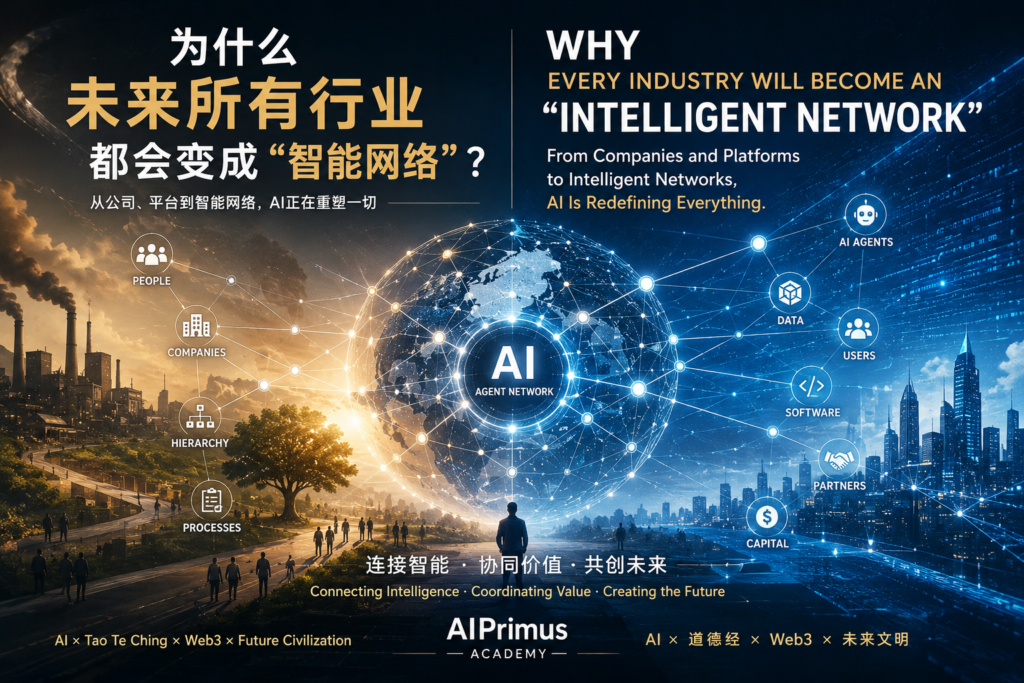
From Companies and Platforms to Intelligent Networks: How AI Is Redefining the Structure of Industry
For more than two centuries, one of humanity’s fundamental ways of creating wealth has been organization.
Factories organized workers.
Companies organized employees.
Platforms organized users.
The internet organized information.
We have largely lived by an implicit rule:
If you want to accomplish something complex, you build an organization and manage it.
But artificial intelligence is changing something much deeper than simply who does the work.
It is forcing us to reconsider a more fundamental question:
Do we still need to organize work in the same way we have for the past century?
As AI becomes increasingly capable of understanding information, using tools, executing tasks, coordinating with other agents, and making decisions within defined boundaries, the basic structure of industries may begin to change.
For most of modern history, an industry has looked like a value chain.
The emerging model looks increasingly like an intelligent network.
In such a network, humans, AI agents, companies, professional services, data, software, machines, capital, and users are no longer simply passing value from one stage to another.
They interact continuously.
They coordinate dynamically.
They execute through software.
And they learn from feedback.
This leads to a much larger conclusion:
AI is not merely transforming jobs. It is transforming the way entire industries are organized.
01 | Why Did Industries Need Layers of Management?
Start with a simple question:
Why do companies exist?
At the surface, companies exist to make money.
But at a deeper level, companies solve a much more fundamental problem:
How can large numbers of people who do not know each other work together over long periods of time?
This problem became particularly important during the Industrial Revolution.
A factory might employ hundreds, thousands, or even tens of thousands of people.
They possessed different skills.
They performed different tasks.
They worked at different stages of production.
So organizations developed hierarchical structures:
CEO
↓
Executives
↓
Departments
↓
Managers
↓
Employees
Information moved upward.
Instructions moved downward.
Departments were connected through procedures and management systems.
This structure did not emerge because human beings particularly enjoy hierarchy.
It emerged because, in the industrial era:
communication was expensive, information was scarce, decision-making was slow, and execution required large amounts of human labor.
Organizations therefore became mechanisms for reducing coordination costs.
In this sense, a company can be understood as:
A Human Coordination Protocol.
The internet began to loosen this structure.
Information could move almost instantly.
Platforms could replace some traditional intermediaries.
People around the world could connect directly.
But most companies still retained industrial-era organizational structures.
Why?
Because:
Being connected does not mean being able to coordinate autonomously.
The internet solved much of the problem of connection.
AI is beginning to address something deeper:
Understanding, Decision-Making, and Execution.
And that is where the next organizational revolution may begin.
02 | AI Is Not Just Replacing Jobs. It Is Reducing Coordination Costs.
When people talk about AI, one of the first questions they ask is:
“Will AI replace this profession?”
But this is still largely an Industrial Age way of thinking.
A more important question is:
Can AI dramatically reduce the cost of coordinating people, information, and resources?
If the answer is yes, entire industries can be reorganized.
Consider a traditional market research process.
It might involve:
Researcher
↓
Data Analyst
↓
Product Manager
↓
Department Head
↓
Executive Team
Today, an AI system can already perform large parts of information gathering, organization, analysis, and preliminary decision-making.
Take this one step further.
A Research Agent conducts research.
A Data Agent analyzes information.
A Content Agent creates content.
A Marketing Agent runs campaigns.
A Customer Service Agent handles routine interactions.
A Finance Agent manages financial workflows.
A Coding Agent develops software.
And these agents can increasingly interact with one another.
The organization begins to evolve from:
“Many people forming an organization”
toward:
“A small number of humans designing a system in which large numbers of intelligent nodes collaborate.”
This is the deeper meaning of an AI-First mindset.
It is not simply about inserting AI into an existing workflow.
The more important question is:
If we were designing this process from scratch in an AI-native environment, what would it look like?
The practical work of AIPrimus Academy follows this direction: from image generation, video production, digital humans, presentations, podcasts, and content creation to multi-tool AI workflows, the emphasis is not simply on learning individual tools, but on developing the habit of thinking with AI and applying it to real-world value creation.
The deeper transformation is therefore not the disappearance of one particular job.
It is the transformation of:
The connections between jobs.
03 | When AI Becomes a Node, Industries Shift From Chains to Networks
Traditional industries are easy to visualize as value chains.
Consider the automotive industry:
Suppliers
↓
Components
↓
Factories
↓
Dealers
↓
Consumers
It is a relatively linear structure.
An intelligent network looks very different.
It is closer to:
                    AI Agent
                       ↕
Supplier ↔ Data ↔ Company ↔ User
   ↕                    ↕
Machines ↔ Software ↔ Professional Services
   ↕                    ↕
Capital ↔ Communities ↔ Global Talent
There is no longer a single fixed upstream or downstream relationship.
Each node may simultaneously become a:
Producer + Consumer + Service Provider + Coordinator.
More importantly, the nodes themselves become increasingly intelligent.
In the past:
Networks connected people.
Today:
Networks increasingly connect intelligence.
Tomorrow:
Networks may connect intelligent nodes capable of taking autonomous action.
This is why the structure of industries may increasingly resemble:
Intelligent Networks.
04 | Why Will Every Industry Eventually Be Affected?
Because almost every industry ultimately performs three fundamental functions:
Gather information.
Make decisions.
Take action.
And AI is increasingly entering all three.
Education needs to understand learners.
Healthcare needs to analyze information.
Finance needs to assess risk.
Manufacturing needs to optimize production.
Logistics needs to plan routes.
Legal services need to interpret rules.
Marketing needs to understand customers.
Scientific research needs to process knowledge.
Media needs to produce and distribute content.
Management needs to coordinate resources.
These industries appear completely different on the surface.
But their underlying logic is surprisingly similar:
Information → Judgment → Coordination → Execution → Feedback
As AI takes over increasing portions of this loop, the structure of an industry begins to change.
So the more important question is no longer:
“Will AI enter this industry?”
It is:
When will this industry become capable of increasingly autonomous sensing, decision-making, coordination, and execution?
As these capabilities mature, an industry stops looking merely like a collection of human professions.
It starts looking like:
A continuously operating intelligent system.
05 | The Future Company May Be Just One Node in an Intelligent Network
This may be one of the most important organizational shifts of the AI era.
In the traditional economy:
Company = Center of Value Creation
In the emerging network economy:
Company = Node in a Value Network
A company may have its own AI agents.
At the same time, it may call external AI services.
It may connect independent professionals.
It may connect suppliers.
It may connect open-source communities.
It may connect users.
It may connect data networks.
It may connect other companies.
It may even interact with DAOs, smart contracts, and digital asset systems.
As a result, the boundary of the company becomes increasingly fluid.
The old question was:
“Which company owns this activity?”
The emerging question may become:
“Which network does this activity belong to?”
This is why future organizations may increasingly evolve from closed institutions into open ecosystems.
AI agents handle execution.
Web3 may provide mechanisms for governance and incentives.
Protocols coordinate interactions.
Humans define goals, values, constraints, and critical decisions.
The result is a new organizational model:
Humans + AI + Protocols + Networks.
AIPrimus Academy’s broader framework follows a similar evolutionary logic: agricultural civilization relied heavily on authority, industrial civilization relied on organizations, the internet era relied on platforms, and an AI civilization may increasingly rely on intelligent systems and self-organizing networks.
06 | Why Might Web3 Matter Again?
If AI gives us:
Intelligent execution,
another fundamental question remains:
Who sets the rules?
Who owns the network?
Who receives the value?
Who participates in governance?
Who verifies outcomes?
This is where Web3 may regain strategic significance.
AI addresses:
“How do we do it?”
Web3 is more concerned with:
“Under what rules do we do it?”
DAOs offer one possible model:
Shared Objective
↓
Governance Protocol
↓
AI Agent Network
↓
Distributed Collaboration
↓
Continuous Feedback
↓
System Evolution
The most important contribution of Web3 may therefore not be cryptocurrency itself.
It is the possibility that:
Organizations can become programmable.
Rules can be encoded.
Incentives can be encoded.
Collaboration can be networked.
Execution can be automated.
As this happens, the boundaries between companies, communities, platforms, open-source projects, and learning organizations may become increasingly blurred.
An organization no longer necessarily needs:
- an office,
- a large workforce,
- or a traditional corporate hierarchy.
It may simply be:
A Set of Objectives + A Set of Protocols + An Intelligent Network.
07 | Wu Wei: A Design Principle for Intelligent Systems
If we only look at the technology, we might conclude:
AI is an engineering problem.
Agents are a software problem.
Web3 is a technological or financial problem.
But when these developments are viewed together, they point toward a much older question:
How can a complex system maintain order without being excessively controlled?
This is one of the questions explored throughout the Tao Te Ching.
Wu Wei is often translated as “non-action,” but that translation can be misleading.
In the context of system design, AIPrimus interprets Wu Wei more usefully as:
Minimum Necessary Intervention.
A sophisticated system does not require humans to manually control every step.
Instead:
Humans define the boundaries.
Systems execute.
Feedback corrects errors.
Networks coordinate.
Protocols maintain order.
This has a striking parallel with the evolution of AI agents.
Traditional software:
Input → Execution → Output
Agentic systems:
Goal → Planning → Tool Use → Collaboration → Correction → Execution
The role of humans therefore changes.
In the past:
Humans managed every step.
Today:
Humans increasingly define objectives.
Tomorrow:
Humans may increasingly design systems.
This is one of the central ideas behind AIPrimus Academy:
Human beings are moving from executors toward designers of intelligent systems.
08 | The Most Valuable People May No Longer Be the Best Executors
If industries increasingly become intelligent networks, an unavoidable question follows:
What should humans do?
The answer may not be:
Do more.
It may be:
Do less — but do what matters more.
AI is increasingly capable of:
- Searching
- Analyzing
- Writing
- Coding
- Generating images
- Producing video
- Processing data
- Organizing information
- Executing workflows
- Coordinating multiple tools
As these capabilities expand, the scarce human capabilities may move upward in the value hierarchy:
Defining problems.
Choosing objectives.
Establishing evaluation criteria.
Designing systems.
Designing rules.
Creating incentives.
Deciding what is worth doing.
This represents a transition:
Executor
to
Designer
then toward:
System Architect
and potentially:
Civilization Architect.
Industrial civilization needed laborers.
The information economy needed knowledge workers.
The AI economy may increasingly need people who can design intelligent organizations, governance systems, and adaptive institutions.
The scarce skill may no longer be knowing how to perform every task.
It may be knowing:
What should the system be designed to accomplish?
09 | The Competitive Advantage of the Future May Be the Ability to Connect More Intelligence
Competition used to be about:
Who owned more factories.
Who had more capital.
Who employed more workers.
Then it became:
Who had more data.
Who had more users.
Who built the larger platform.
In the AI era, competition may evolve again:
Who can organize more intelligence?
And “intelligence” no longer refers only to human intelligence.
It may include:
- Human experts
- AI agents
- Open-source communities
- Data networks
- Software systems
- Autonomous machines
- Global talent
- Digital assets
- Professional services
The strongest organization may not own all of these resources.
It may simply be the organization that can:
Connect them effectively.
This changes the meaning of competitive advantage.
It may become less about:
Ownership
and more about:
Connection.
Less about:
Control
and more about:
Coordination.
Less about:
Hiring more people
and more about:
Organizing more intelligence.
This leads to a central AIPrimus proposition:
In the AI era, competition is increasingly not just between people or companies, but between systems.
10 | From the Internet Connecting Information to AI Connecting Intelligence
If we zoom out and look at civilization over a longer time horizon, a fascinating pattern emerges.
Agricultural civilization:
Connected land and people.
Industrial civilization:
Connected machines and labor.
The internet era:
Connected people and information.
The AI era:
Connects intelligence with intelligence.
And the next stage may be:
Connecting intelligent networks capable of autonomous action.
This could fundamentally change what the internet itself means.
In the past, we went online to:
Find information.
Later, we went online to:
Use platforms.
In the future, we may no longer simply “go online.”
Because:
The network itself may act on our behalf.
You define an objective.
Your personal AI agent searches for resources.
It communicates with other agents.
Those agents interact with companies and services.
Those services interact with software and machines.
Eventually, the network coordinates the completion of the task.
You may only see the final result.
Behind that result, however, an enormous amount of machine-to-machine collaboration may have taken place.
This is the deeper meaning of an emerging:
Agent Economy.
Conclusion | The Biggest Industry of the Future May Be the Intelligent Network Itself
So when we ask:
“Which industry will have the greatest future?”
Perhaps the question itself is becoming outdated.
The transformation may not simply be:
One industry disappears.
Another industry emerges.
Instead:
Every industry becomes increasingly networked.
Every industry becomes increasingly intelligent.
Every organization becomes increasingly platform-like.
Every workflow becomes increasingly agentic.
Every form of collaboration becomes increasingly protocol-driven.
As this happens, the boundaries between industries will become increasingly fluid.
Education will connect content, AI, communities, and careers.
Finance will connect AI, data, assets, and global networks.
Manufacturing will connect robotics, supply chains, software, and intelligent decision-making.
Media will connect creators, AI, audiences, and distribution networks.
Companies will connect employees, agents, communities, capital, and protocols.
And individuals may no longer be merely:
Consumers.
They may become:
Intelligent Nodes.
That may be the most profound change of all.
We created the internet to connect people.
The next generation of networks may exist to:
Connect Intelligence.
When intelligence can flow freely,
when AI agents can collaborate autonomously,
when protocols can coordinate value,
and when organizations can increasingly operate as adaptive systems,
we are no longer talking about a simple technological upgrade.
We are looking at:
An Organizational Revolution.
An Economic Revolution.
A Governance Revolution.
And ultimately, perhaps:
A Civilization Revolution.
The Tao Te Ching idea of Wu Wei does not necessarily mean that humans should stop acting.
It may point toward something much more sophisticated:
The highest form of system design is not to make everyone control the world more aggressively, but to create systems that can continue operating, learning, correcting, and evolving without requiring constant human intervention.
That may be one of the most important questions of the AI era:
When intelligence becomes a network, and networks become intelligent, what will civilization become?
Perhaps the answer will not be found in any single industry.
It may be found in:
The Intelligent Network Itself.
AIPrimus Academy
AI × Tao Te Ching × Web3 × Future Civilization
Training AI Thinking. Upgrading Human Cognition.
Related Reading
The Future of Wealth Is Not Ownership, but Connection
Why the Most Valuable Asset in the Future Isn’t Knowledge, but Cognitive Frameworks
Why “Wu Wei” May Be the Most Advanced AI System Design Principle
Why Humans Are Becoming Designers in the AI Agent Era
Web3 Is Not a Financial Revolution, but a New Governance Model
Pingback: The Future of Civilization: From Efficiency to Resilience | AIPrimus